
Articles · Facades Northwest · Originally published October 2026
A practical guide to understanding exterior-wall fire testing without getting lost in the terminology.
Does the building need NFPA 285 compliance? Does the cladding need it? What happens when a designer changes the insulation or selects a different water-resistive barrier?
Before answering those questions, it helps to separate three issues: what the test evaluates, what triggers the code requirement, and what documentation supports the proposed wall. This guide addresses all three: what NFPA 285 evaluates, when the code requires it, and how to read the documentation supporting the wall.
1. What Is NFPA 285—and Why Does It Exist?
NFPA 285 is a standardized fire test for evaluating how fire spreads across and within an exterior wall assembly containing combustible components. Its formal title is Standard Fire Test Method for Evaluation of Fire Propagation Characteristics of Exterior Wall Assemblies Containing Combustible Components. [7]
The central question is straightforward:
When an exterior wall is exposed to the prescribed fire conditions, does the assembly limit fire spread within the test’s acceptance criteria?
The test addresses a scenario in which a fire inside a building develops sufficiently to expose the exterior wall through a window opening. That exposure can affect the wall above and beside the opening—not just the room where the fire began. The test uses an interior-room burner and an exterior-window burner to create the prescribed exposure. [1, p. 2]
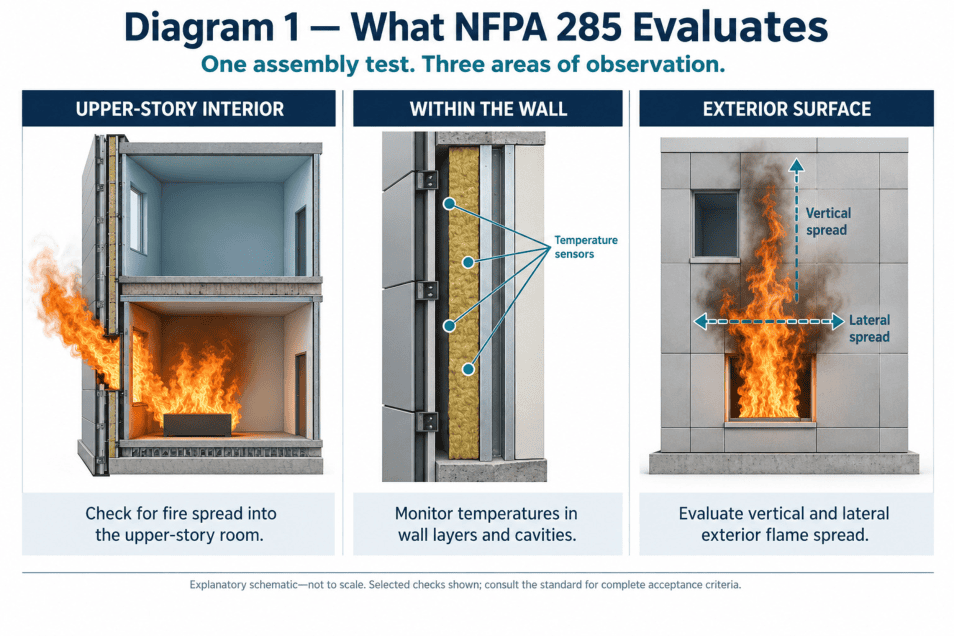
Diagram 1 — What NFPA 285 Evaluates. One assembly test; three areas of observation. Original AI-assisted explanatory schematic, not to scale. Selected checks shown—not a complete test-apparatus drawing or substitute for the standard. Technical context: [1, p. 2].
It looks beyond the visible cladding
The test evaluates more than flames on the outside face. It considers fire propagation over the exterior surface, within combustible components and cavities, and from the lower story toward the upper story. The test assembly represents a two-story arrangement, with temperature measurements and visual observations collected during a 30-minute fire exposure. [1, p. 2; 7]
This is why the arrangement of materials matters.
Cladding, insulation, membranes, air spaces, and attachment configurations do not operate independently during the test. Changing a component or changing how the components are arranged can affect the result. The technical bulletin supporting this article specifically cautions that assembling products used in separate passing tests does not establish that their new combination will pass. [1, p. 3]
NFPA 285 evaluates a wall assembly—not an individual product in every possible installation.
A statement such as “this panel has passed NFPA 285” therefore needs another question:
“In what assembly, and does that documentation cover the wall we intend to build?”
A passing test establishes the performance of the documented assembly under the prescribed test conditions. Changes may require additional supporting analysis or testing; a result does not automatically follow an individual component into every new combination. [1, pp. 2–3]
The code and the test have different jobs
One distinction belongs at the beginning of every NFPA 285 discussion:
The building code establishes when NFPA 285 compliance is required. The NFPA 285 standard establishes how the assembly is tested and evaluated.
The test standard is not a stand-alone decision chart for determining which buildings need it. That determination comes from the applicable code provisions governing the construction type, wall materials, and installation conditions. [4; 5]
2. What Determines Whether NFPA 285 Applies?
The initial review should begin with the building and the complete wall assembly—not with a single product description.
The following factors organize that review.
The adopted code and local amendments
Identify the code edition governing the project and any jurisdiction-specific changes. The IBC is a model code; jurisdictions can amend its provisions when adopting it. A chart based on one edition is therefore a reference tool, not a substitute for confirming the project’s actual requirements. [6]
The construction type
Confirm the building’s formal construction classification.
Types I, II, III, and IV are potentially subject to the exterior-wall NFPA 285 provisions discussed here. Type V is generally outside those principal model-code triggers, but that does not remove its other exterior-wall fire requirements. [4, §2603.5; 5]
Type IV also deserves closer attention. IV-HT, IV-A, IV-B, and IV-C should not be treated as interchangeable. The 2021 IBC distinguishes the exterior-material restrictions for IV-A/B/C from the heavy-timber provisions. For those buildings, material permissibility must be checked as well as any applicable fire-test requirement. [3, §602.4]
The components in the wall
Identify the full wall build-up, including the cladding, insulation, water-resistive barrier, sheathing, and other relevant components.
The 2021 IBC chart directs readers through separate questions for:
- Water-resistive barriers, commonly abbreviated WRBs.
- Metal composite materials, or MCMs, and high-pressure laminates, or HPLs.
- Foam plastic insulation, including applicable exceptions. [2]
These are separate code pathways. A conclusion about the cladding does not automatically resolve requirements associated with the insulation or WRB.
For example, the 2021 IBC expressly directs HPL systems containing foam plastic insulation to the foam-plastic provisions of Section 2603. [5, §1408.13]
Height and installation location
Height matters—but its role depends on the provision being applied.
The 2021 IBC distinguishes the height condition associated with combustible WRBs from the installation-height provisions for MCM and HPL. Foam plastic has a different starting point: the applicable exterior-wall provisions address Types I–IV of any height, subject to exceptions. [4, §2603.5; 5]
Do not substitute a general statement such as “the building is under 40 feet” for the height measurement and conditions specified by the relevant section.
Exceptions and their conditions
An exception is useful only when the proposed wall satisfies its conditions.
For example, the WRB exceptions in the 2021 IBC depend on the WRB being the only combustible component, together with specified covering or material-performance conditions. The HPL alternative includes installation-height, fire-separation-distance, and coverage considerations. The foam-plastic exceptions have their own assembly conditions. [4, §2603.5.5; 5, §§1402.5, 1408.11]
The word “exception” is not the end of the review. It is the beginning of checking whether that exception actually fits the project.
3. Use Diagram 2 to Organize the Review
Diagram 2 uses the 2021 International Building Code as its reference edition. A project must follow its adopted code and applicable amendments, which may differ from the model-code provisions summarized here. [2, 6]
Once the construction type, materials, height, and jurisdiction are identified, a decision chart can help organize the applicable questions.
Diagram 2 summarizes NFPA 285-related provisions from the 2021 IBC. It separates WRB, MCM, HPL, and foam-plastic questions and identifies code sections for further review. [2]
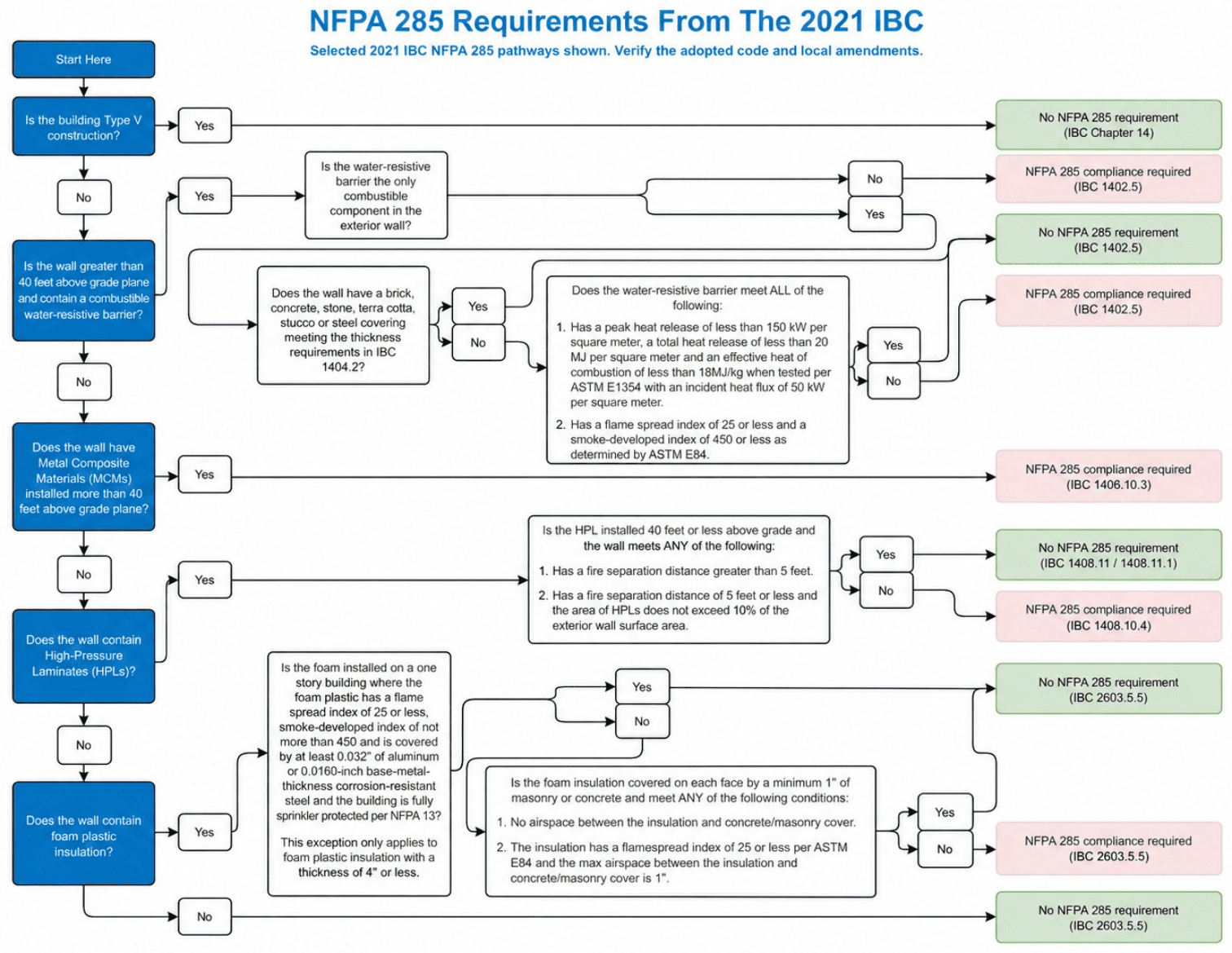
Other pathways: Exterior FRP may also trigger NFPA 285 under IBC §§2613.5 and 2603.5.5. EIFS with foam plastic is addressed through the foam-plastic provisions. Other combustible exterior wall coverings may have separate requirements, including NFPA 268, outside the scope of this flowchart.
An exception for one component is not an exemption for the entire wall
The chart should help identify relevant provisions—not encourage the reader to stop at the first favorable answer.
A wall can contain more than one component subject to separate requirements. For example, satisfying an HPL-specific alternative does not resolve the foam-plastic provisions when foam insulation is also present. The 2021 IBC’s HPL section expressly requires that additional review. [5, §1408.13]
The practical approach is to record the answer for each applicable material, including the section and exception relied upon, then evaluate the combined result.
Check every applicable branch. One “not required” result does not automatically clear the entire wall.
Also distinguish two different questions:
Is the proposed material permitted in this construction type and location?
If it is permitted, does the proposed assembly require NFPA 285 compliance?
The 2021 IBC makes this distinction for Type IV-A/B/C exterior coverings and other combustible-cladding limitations. A passing fire-propagation test does not, by itself, override a separate restriction on material use. [3, §602.4; 5, §1405]
NFPA 285 is not a permission slip to disregard the rest of the building code.
4. Why There Is No Universal “40-Foot Rule”
“NFPA 285 only applies above 40 feet.”
That statement is too broad.
The 2021 IBC identifies several provisions involving 40 feet, but it also identifies foam-plastic requirements that apply to Types I–IV without that minimum height threshold. [4, §2603.5; 5]
A building below 40 feet can still require compliance
The 2021 IBC’s Section 2603.5 addresses exterior walls of Types I, II, III, and IV of any height. Within those foam-plastic provisions, Section 2603.5.5 establishes the NFPA 285 requirement and identifies exceptions. [4]
A low-rise building containing foam plastic insulation in its exterior wall therefore cannot be dismissed from review simply because it is short.
The relevant question becomes:
Does the proposed wall fall within the foam-plastic requirement, and does it satisfy an applicable exception?
A building above 40 feet does not automatically require compliance solely because of its height
The opposite assumption is also unreliable.
The combustible-WRB provisions include exceptions for qualifying walls. A wall meeting such an exception may avoid that particular NFPA 285 trigger, provided no other applicable component or provision creates the requirement. [5, §1402.5]
Height is one input. It is not the complete decision.
A low-rise example: the cladding stays the same, but the review changes
Consider this example: a 35-foot Type II building with metal composite cladding installed below the applicable 40-foot threshold.
A proposed wall using mineral wool still requires review of the cladding provisions, WRB, and other applicable conditions. The absence of foam plastic does not, by itself, establish that the entire assembly is exempt. [5, §§1402.5, 1406.10]
Now change the insulation to polyisocyanurate foam, commonly called polyiso, while leaving the building height and cladding unchanged.
The foam-plastic exterior-wall provisions now become relevant. Under the Type I-IV “any height” provisions, NFPA 285 compliance is required unless the proposed arrangement satisfies an applicable exception. [4, §§2603.5, 2603.5.5]
The visible cladding did not change. The building did not become taller.
What changed was a component within the wall – and the code provision that must be evaluated.
That is why the starting question should be:
“Does this proposed wall assembly require NFPA 285 compliance?”
– not simply:
“Is the building taller than 40 feet?”
5. Engineering Judgments: When You Don’t Have the Exact Tested Assembly
A common misconception is that every wall assembly requiring NFPA 285 must match a physically tested assembly exactly. Direct testing is one compliance path, but it is not always the only one.
When a proposed wall differs from a tested wall, a qualified engineer can sometimes analyze those differences using successful NFPA 285 test data as the technical basis. This is commonly called an engineering judgment, engineering analysis, or extension of test data. [1; 8]
An engineering judgment does not replace the need for NFPA 285 test data. It uses relevant passing test data to evaluate whether a modified assembly can be accepted without physically testing that exact configuration.
What can an engineering judgment evaluate?
Potential changes may include different claddings, WRBs, insulation types or thicknesses, sheathing, cavity dimensions, drainage layers, attachment systems, and window-perimeter or fire-stopping details. Not every change can be justified analytically. If the differences are too significant – or the supporting data is too limited – additional testing may still be required. [1; 8]
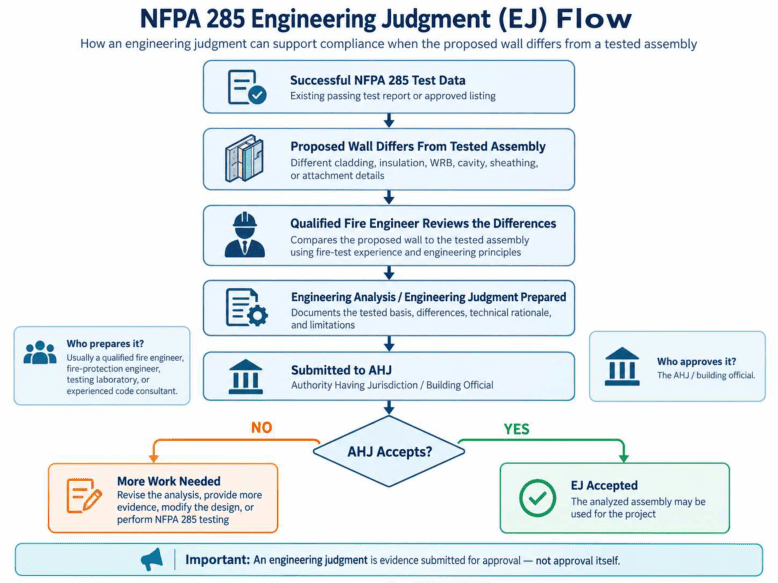
Diagram 3 – Engineering Judgment (EJ) Review Path
Conceptual workflow for how tested data, engineering analysis, and AHJ approval can support a modified wall assembly.
Can an engineering judgment take the place of a new physical test? Yes – sometimes. A properly supported analysis can allow a proposed wall assembly to demonstrate NFPA 285 compliance without physically testing that exact wall, provided it is based on relevant successful test data and is accepted by the Authority Having Jurisdiction (AHJ). The 2024 IBC expressly recognizes three paths: (1) the actual assembly is tested and passes NFPA 285, (2) the wall design is listed by an approved agency, or (3) an approved analysis is based on a tested assembly or condition. [8; 10]
Who prepares it? Typically, a qualified fire-protection engineer, fire engineer, testing laboratory, or code consultant with specific NFPA 285 experience prepares the analysis. The document should identify the tested assembly it relies on, the proposed project assembly, every difference between them, and the technical rationale for why those differences are not expected to adversely affect fire performance.
Who approves it? The AHJ – usually the building official, and sometimes in coordination with the fire official – decides whether the analysis is acceptable for the project. The engineer issuing the judgment does not approve the project, and a manufacturer does not approve compliance simply by providing a letter.
Can it be rejected? Absolutely. An engineering judgment can be rejected if the supporting test is not similar enough, the analysis does not adequately support the combined effect of the proposed changes, the analysis is not adequately explained, the supporting data is insufficient, or the AHJ determines that additional testing is needed. [9]
An engineering judgment is evidence submitted for approval – not approval itself.
What should you ask for? A useful EJ package should identify the original NFPA 285 test or tests, the exact tested wall assembly, the proposed project assembly, each substitution or configuration change, the rationale for each change, any stated limitations, the author's credentials, and whether the AHJ has accepted the analysis for this project.
Practical takeaway Do not treat an engineering judgment from another project as automatically applicable to your wall. The value of the analysis depends on the relationship between the supporting test data and the actual assembly being proposed.
6. Approval Is Not the Finish Line
A wall assembly does not become “NFPA 285 compliant” simply because a test report, listing, or engineering judgment exists somewhere in the project file.
The assembly that is designed, submitted, purchased, and installed must still match the assembly that was approved.
That is where many projects get into trouble. The design team may identify a compliant path early, but later changes in products, dimensions, or detailing can move the installed wall away from the documented assembly. A substitution that seems minor from a purchasing or installation standpoint can still affect whether the supporting test, listing, or engineering judgment applies.
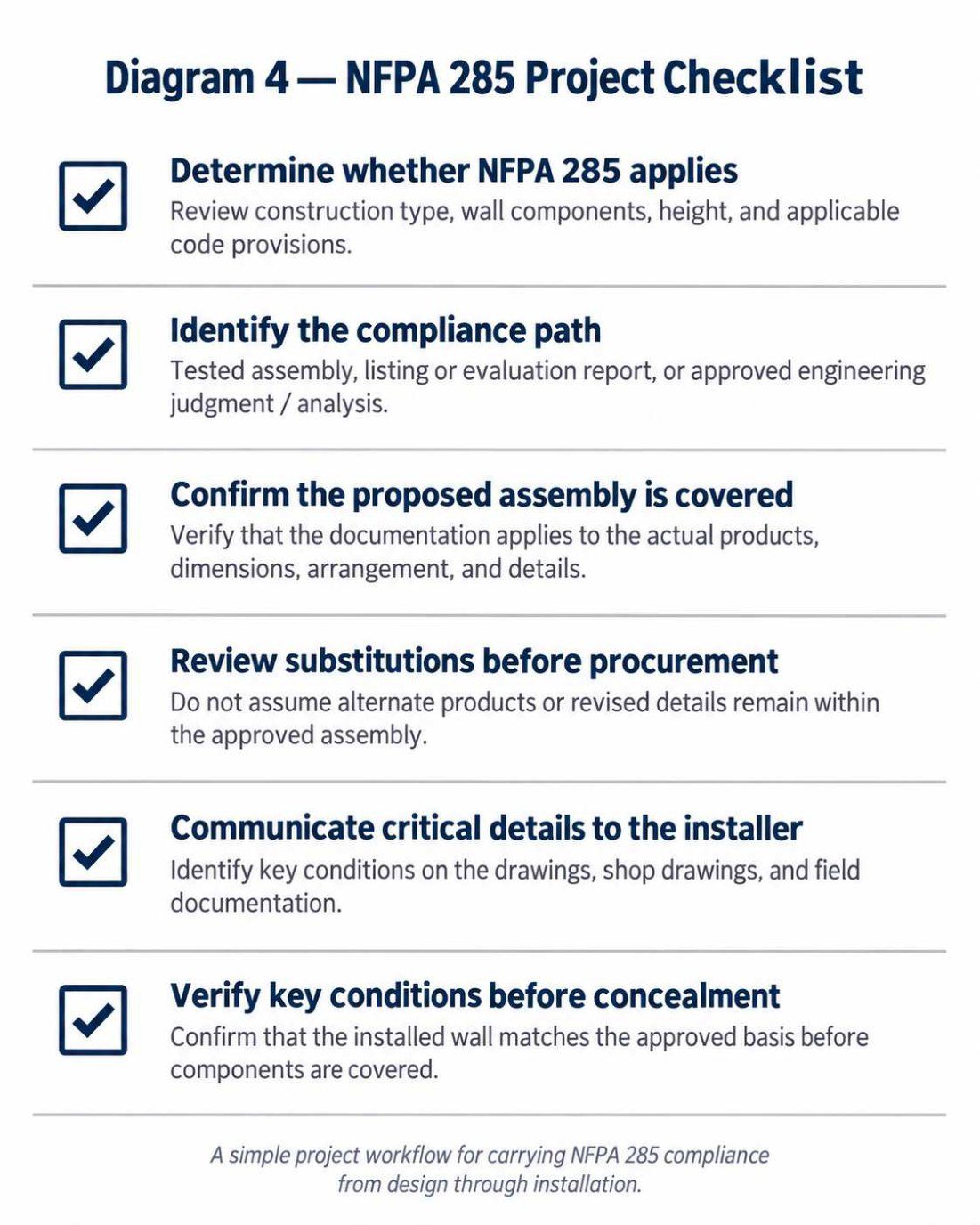
In practical terms, NFPA 285 compliance needs to carry through the entire process:
- drawings and specifications
- submittals and shop drawings
- procurement and substitutions
- installation sequencing
- field coordination at openings, transitions, and penetrations
The project team should pay particular attention to details that can materially affect the wall assembly, including:
- insulation product and thickness
- sheathing type
- water-resistive barrier product and location
- cavity depth
- clips, girts, rails, or other attachment components
- cladding configuration and joint conditions
- window-opening details
- perimeter fire-containment and transition details
Window and opening details deserve special attention. Published assembly documentation can identify opening treatments and other details as critical to maintaining the basis of NFPA 285 compliance. [15]
NFPA 285 compliance has to survive the transition from the approved assembly to the installed wall.
A useful project approach is to identify the critical compliance details on the drawings, verify those conditions before they are concealed, and route proposed substitutions back through the review process before installation.
The project team should designate one responsible party – such as the architect, envelope consultant, code consultant, or another assigned team member – to maintain the approved assembly documentation and route substitutions for review before installation. Contractual responsibility varies by project.
7. NFPA 285 Is Not the Same as Other Fire Tests
Another common source of confusion is the assumption that different fire-test terms mean the same thing. They do not.
Several familiar fire tests address very different performance questions. A material or assembly may satisfy one test and still require separate evaluation under another.
Fire-Test Comparison
| Test | What it evaluates |
|---|---|
| ASTM E84 | Surface flame spread and smoke development |
| ASTM E136 | Material noncombustibility |
| ASTM E119 / UL 263 | Fire resistance, including hourly assembly ratings |
| NFPA 285 | Fire propagation across and within an exterior-wall assembly |
| ASTM E2307 | Perimeter fire containment at the exterior-wall / floor intersection |
Sources for the comparison: NFPA 285 [7], ASTM E84 [11], ASTM E136 [12], ASTM E119 [13], and ASTM E2307 [14].
“Class A,” “noncombustible,” “two-hour rated,” and “NFPA 285 compliant” are not interchangeable descriptions.
A product may be described as Class A, noncombustible, or part of a two-hour rated assembly, but none of those descriptions automatically establishes that the exterior wall assembly is compliant with NFPA 285. Likewise, an assembly supported by NFPA 285 documentation does not automatically establish compliance with unrelated requirements such as perimeter fire containment.
Each term answers a different question. Designers, contractors, and owners should therefore confirm that the documentation being relied upon addresses the specific requirement actually at issue.
8. How to Read the Compliance Documentation
When a manufacturer or consultant says a wall has “NFPA 285 documentation,” the next step is to determine what kind of documentation it is and what it actually covers. The 2024 IBC explicitly recognizes direct testing, approved listings, and approved engineering analyses as compliance paths where NFPA 285 is required. [10]
Test Report A test report documents what was physically constructed, tested, and observed. It is the most direct record of the assembly that went through the NFPA 285 procedure. It shows the actual basis of performance, but it documents the assembly that was tested – not every possible variation of that assembly.
Listing or Evaluation Report A listing or evaluation report describes the assemblies, configurations, products, or conditions that the issuing agency recognizes as covered. It may describe permitted components, limitations, and conditions that must be satisfied for the documented assembly to remain within scope.
Engineering Judgment / Engineering Analysis An engineering judgment or engineering analysis addresses specific departures from a tested assembly. It uses successful NFPA 285 test data, engineering principles, and technical analysis to evaluate whether a modified assembly can be accepted without physically testing that exact configuration. It applies only to the conditions and changes it specifically addresses.
The real question is not whether someone has NFPA 285 paperwork. The question is whether the documentation covers the wall that is actually being built.
For projects under the 2021 IBC, alternative materials, designs, and methods were addressed through Section 104.11 and required approval by the building official. The 2024 IBC makes the NFPA 285 analysis pathway explicit in Section 1402.8. [9; 10]
The issue is not whether a fixed number of components has changed. The real question is whether the available evidence adequately supports the combined effect of the proposed changes.
References & Illustration Credits
[1] DuPont. NFPA 285: Air/Water-Resistive Barriers (WRB) and Foam Plastic Insulation. Technical Bulletin, June 2021, Form No. 43-D100990-enUS-0621. Pages 2-3 support the test and assembly discussion; the bulletin’s code discussion primarily uses the 2018 IBC. View source
[2] The Building Code Blog. NFPA 285 Requirements From the 2021 IBC. Diagram 2 is adapted from the user-supplied chart. Presentation modified; selected decision paths retained and verified as described in the diagram note. View source
[3] International Code Council. 2021 IBC, Chapter 6, Section 602.4. Type IV construction, including exterior-material restrictions for IV-A/B/C and the IV-HT provisions. View source
[4] International Code Council. 2021 IBC, Chapter 26, Sections 2603.5 and 2603.5.5. Foam-plastic exterior-wall provisions and NFPA 285 exceptions. View source
[5] International Code Council. 2021 IBC, Chapter 14. Includes the WRB, MCM, HPL, and related exterior-wall provisions used in Diagram 2. View source
[6] International Code Council. International Building Code (IBC). Model-code and jurisdictional-adoption background. View source
[7] Intertek. NFPA 285. Published overview of the test purpose and assembly approach. View source
[8] International Code Council, Building Safety Journal. Beyond the Wall: Decoding the 2024 International Building Code and NFPA 285 Fire Safety Evolution. Background on the 2024 compliance pathways and engineering analyses. View source
[9] International Code Council. 2021 IBC Section 104.11 – Alternative materials, design and methods of construction and equipment. Provides the building-official approval framework for alternative methods and supporting evidence. View source
[10] International Code Council. 2024 IBC Section 1402.8 – Vertical and lateral flame propagation compliance methods. Recognizes direct testing, approved listings, and approved engineering analyses based on successful NFPA 285 testing. View source
[11] ASTM International. ASTM E84 – Standard Test Method for Surface Burning Characteristics of Building Materials. View source
[12] ASTM International. ASTM E136 – Standard Test Method for Assessing Combustibility of Materials Using a Vertical Tube Furnace at 750 C. View source
[13] ASTM International. ASTM E119 – Standard Test Methods for Fire Tests of Building Construction and Materials. View source
[14] ASTM International. ASTM E2307 – Standard Test Method for Determining Fire Resistance of Perimeter Fire Barriers Using Intermediate-Scale, Multi-story Test Apparatus. View source
[15] DuPont. NFPA 285 Compliant Wall Assemblies With DuPont Tyvek Commercial Air and Water Barrier Systems. Illustrates assembly-specific window and opening details identified as critical to maintaining NFPA 285 compliance. View source
Illustration Credits
Diagram 1: Original AI-assisted illustration prepared for Facades Northwest. It illustrates selected observation areas described in [1] and is schematic, not an exact representation of the prescribed test apparatus.
Diagram 2: Adapted from [2]. Promotional branding removed for article layout. The diagram summarizes selected 2021 IBC NFPA 285 pathways most commonly encountered in exterior-wall assemblies, including combustible WRBs, MCM, HPL, and foam plastic. FRP and other special conditions should be reviewed under the applicable Chapter 14 and Chapter 26 provisions.
Diagram 3: Original AI-assisted flowchart prepared for Facades Northwest to explain a typical engineering-judgment review path.
Diagram 4: Original AI-assisted project checklist prepared for Facades Northwest to summarize the recommended workflow from code review through field verification.
Download the original article
Download the original PDF with its original page layout, figures and references.
Questions about your building envelope? Contact Facades Northwest.