
Articles · Facades Northwest · Originally published October 2026
How Much Performance Remains When the Cladding Goes On?
Installing the weather barrier early helps protect a building during construction. Yet the membrane providing that protection is itself exposed until subsequent work covers it. That raises a question with consequences well beyond the construction schedule: how much performance remains when the wall is finally enclosed?
This paper examines self-adhered, vapor-permeable weather barriers. These membranes form part of continuous air-and water-control systems, with adhesion and integration at laps, openings and transitions central to their performance. The focus is the durability expected from a fully adhered building-envelope system.
Joe Lstiburek identifies cladding as a UV screen for the control layers behind it. John Straube likewise describes the reduced UV exposure of concealed barriers. [12, 14] Their guidance makes the membrane’s condition at enclosure a central durability question.
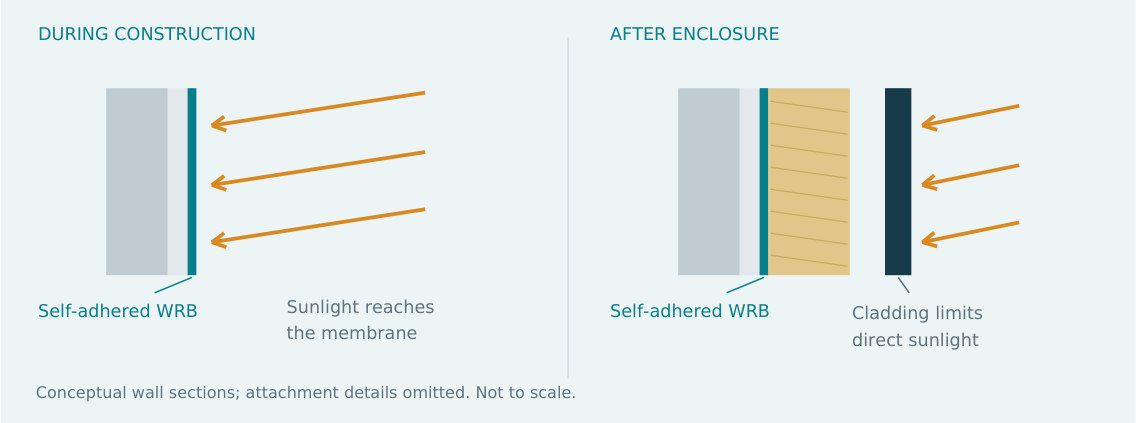
Figure 1. Enclosure changes exposure conditions. It does not restore properties already lost. The membrane remains within the completed wall, where investigation and replacement can involve substantial disruption. [3]
Installing the cladding does not reset the membrane’s performance. The building must rely on what remains underneath.
What the WRB must keep doing
The cladding sheds most rain, but it is not the only line of defense. Water can pass joints, interfaces and other openings. The WRB provides a water-resistive layer behind the cladding, integrated with flashings and drainage paths that direct that water back outside. Its continuing purpose is to protect sheathing, framing and other moisture-sensitive materials. [14, 16]
Water control, air control and drying
The self-adhered membranes reviewed here also serve as components of air-barrier systems. When the field membrane, laps and transitions form a continuous system, they limit air leakage and the heat and moisture it carries. Vapor permeability serves a different role: it permits diffusion through the material and can support drying where the wall design relies on that path. These functions need separate performance evidence. [4-7, 15]
Strength and elongation help the membrane maintain physical continuity under the demands placed on it. UV-related changes matter because the material must continue performing after construction ends. The question is not simply whether the exposed sheet still looks intact, but whether its remaining properties support its intended duty.
Why exposure lasts longer than expected
| Construction condition | How it extends exposure |
|---|---|
| Normal sequencing | WRB installation precedes insulation, attachments and cladding; separate trades may follow different schedules. |
| Supply and coordination delays | Late materials, unresolved details, shop drawings and conflicts at openings can hold up enclosure. |
| Weather, access and work stoppages | Weather interruptions, labor or access constraints, and funding delays can leave installed areas exposed. |
| Inspection and corrective work | Testing, inspections and repairs can postpone covering or require areas to be reopened. |
The presentation identifies scheduling, trade coordination, weather, supply and funding as exposure drivers. [17] Track installation and covering dates by area and elevation: the first wall installed may have a much longer exposure history than the last.
Early installation protects the building. Timely covering protects the membrane that the completed building will depend on.
Permitted exposure before covering
The published limits below govern exposure during construction. They are not service-life predictions or statements that original performance remains unchanged. Dörken varies its allowance by climate zone; the other three products publish a 180-day limit. [4-7]
| Manufacturer / product | Maximum exposure |
|---|---|
| Dörken DELTA-VENT SA | Zone 1: 180 days Zone 2: 270 days Zone 3+: 365 days |
| Henry Blueskin VP160 | Up to 180 days |
| VaproShield WrapShield SA | 6 months (180 days) |
| SOPREMA SOPRASEAL STICK VP | Up to 180 days (6 months) |
Table 1. Manufacturer data [4-7], reviewed October 2026. Follow current instructions and cover promptly.
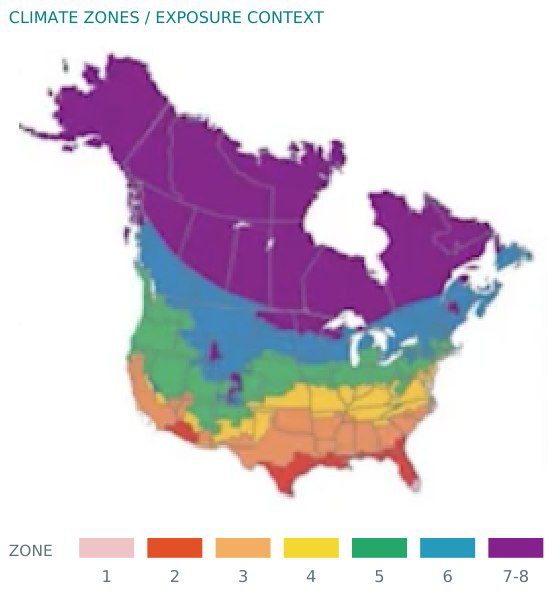
Figure 2. U.S. and Canadian climate zones, reproduced from Dörken’s presentation featuring RDH’s James Bourget [17]. Warmer and cooler colors distinguish climate zones; they do not quantify UV dose. Confirm the applicable project zone with the manufacturer.
The calendar does not measure UV dose
Climate zones classify thermal conditions, not measured UV intensity. Location, season and façade orientation affect solar exposure; temperature and moisture also contribute to weathering. The same number of days can impose different conditions in different places. [8, 18]
An exposure limit is not a damage-free period
The curves show properties changing during exposure. [1] A weathering pass/fail result is useful, but it does not by itself quantify remaining capacity after the construction conditions a project experiences. [7]
Ask what supports the exposure allowance, and what performance remains at the end of it.
What governs UV durability?
Self-adhered describes how a membrane is attached to its substrate. It does not establish how the material will respond to sunlight. Products within that category can differ in composition, layer arrangement and stabilization, with consequences for the performance they retain during exposure. [3]
The construction of the membrane matters
In a layered membrane, different components serve different functions. For example, current DELTA-VENT SA documentation describes polypropylene outer fabrics surrounding a vapor-permeable, watertight polyurethane layer, with a full-surface adhesive for attachment. [4] The polymer formulation, protective layers and stabilizers influence resistance to weathering. [3] The ability to remain attached and the ability to resist water must each be evaluated.
The relevant evidence is therefore specific to the product and formulation supplied. A familiar appearance or a shared attachment method cannot establish equal durability.
Minimum qualification and long-term duty
Meeting an evaluation requirement establishes performance within that evaluation’s scope. It does not answer every question about the membrane’s future service. RDH’s Graham Finch identifies gaps between material specifications and the properties relevant to service, including adhesion and the relationship between laboratory conditioning and field exposure. [11]
For a project team, the useful follow-up is specific: what did the evaluation measure after aging, what level was required, and how do those conditions relate to the expected construction exposure? That connects a qualification result to the decision being made about a particular wall.
How the laboratory exposure works
The study combined xenon-arc light, elevated temperature, controlled humidity and wetting cycles. [2] Its results describe changes under that combined weathering procedure. They do not isolate the share of each loss caused by UV alone. The exposure method belongs beside the results because it defines what the comparison demonstrates. [8]
In his discussion of tapes and adhered systems, Lstiburek describes using outdoor exposure to calibrate accelerated aging tests. [13] That supports asking how a laboratory procedure relates to actual weathering. It does not establish a universal conversion from test hours to construction days.
Water resistance: the core function
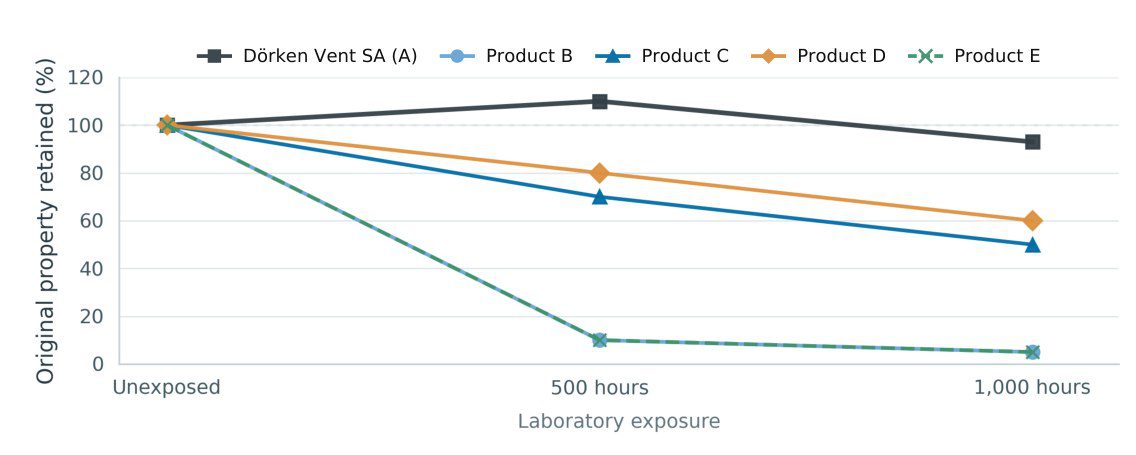
The study measured breaking force, elongation and hydrostatic resistance before exposure and after 500 and 1,000 hours of xenon-arc weathering. It used ASTM D5035 and AATCC 127. Its self-adhered subset contains five coded products. [2]
Dörken Vent SA (A) Product B Product C Product D Product E
Figure 3. Retained hydrostatic resistance. Approximate redraw of the supplied plots [1]; selected values are corroborated in [2]. Each product starts at its own 100% baseline. Lines connect exposure checkpoints; overlapping curves are possible. The Dörken curve represents the earlier composition; see page 8.
What the test measures
Hydrostatic testing evaluates resistance to water penetration under pressure. Lower resistance means that penetration occurs at a lower pressure under the test conditions. It does not measure the percentage of rain entering a completed wall. [9]
What the decline means
The report describes Products B and E retaining about 10% of their original water resistance after 500 hours. Product A retained about 93% after 1,000 hours. [2] Those are substantial differences in retention under the same laboratory exposure.
The practical concern is reduced capacity to resist water that reaches the drainage plane. The remaining absolute resistance and the relevant acceptance requirement are necessary to judge adequacy. A large percentage loss alone does not establish whether the exposed material passes or fails that requirement.
A 90% loss of measured water resistance is not a 90% leak rate. It is a loss of a protective property that needs to be evaluated before concealment.
Strength: capacity to resist rupture
A weather barrier must retain enough physical integrity to survive installation, subsequent construction work and the stresses imposed by its assembly. Breaking-force testing provides one measure of that integrity.
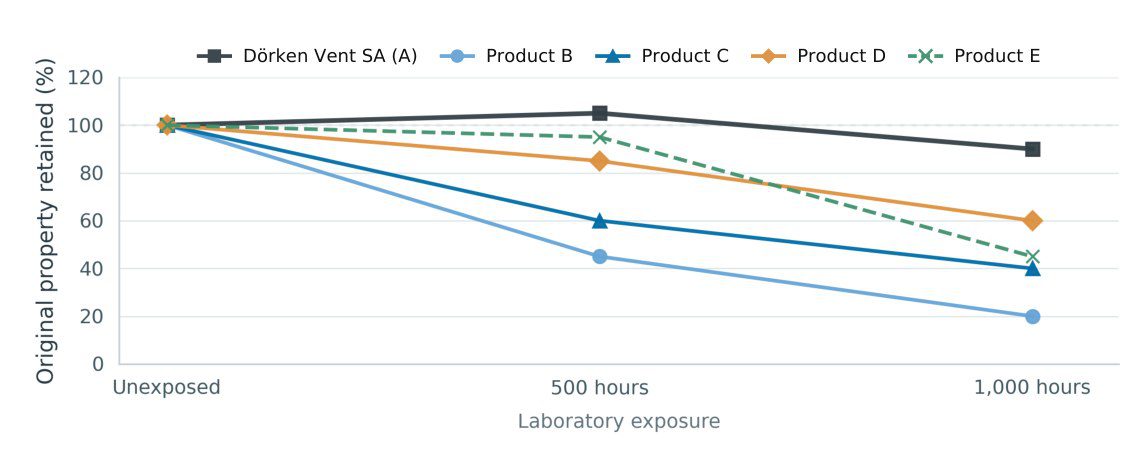
Dörken Vent SA (A) Product B Product C Product D Product E
Figure 4. Retained breaking force. Approximate redraw of the supplied plots [1]; selected values are corroborated in [2]. Each product starts at its own 100% baseline. Lines connect exposure checkpoints; overlapping curves are possible. The Dörken curve represents the earlier composition; see page 8.
What the test measures
The strip test pulls a specimen until it breaks and records the force required. A lower result means less force is needed to rupture that specimen. This measurement is distinct from tear propagation, puncture resistance or adhesive bond strength. [10]
What the decline means
At 1,000 hours, the report describes Product A retaining about 90% of its initial breaking force; the other self-adhered products retained roughly 20% to 60%. [2] Retention varies considerably even among products within the same broad membrane category.
As an engineering interpretation, lower breaking strength leaves less tensile capacity where stresses develop during handling or at details and discontinuities. Fully adhered membranes receive support from the substrate, so installed performance also depends on bond quality, unsupported spans and detailing. This specimen test does not establish whole-wall wind resistance.
Why does Product A initially rise above 100%? The authors interpret its early increase in breaking force as a sign of aging through molecular crosslinking. A gain in one property does not establish improved durability. This explanation is specific to strength; it should not automatically be applied to the water-resistance curve. [2]
Elongation: deformation before rupture
Strength and elongation should be read together. A membrane can retain much of its breaking strength while losing the ability to deform before it ruptures. That change can affect its tolerance of localized movement.
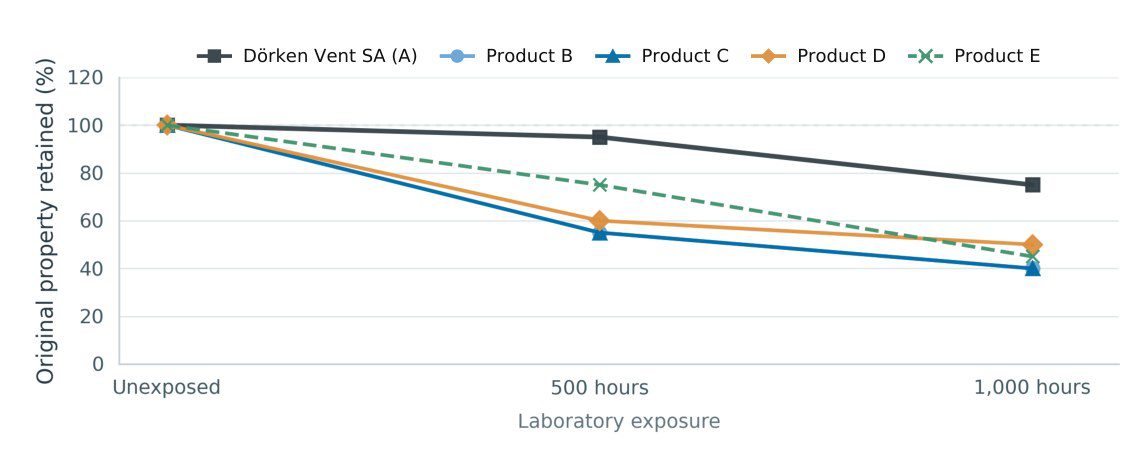
Dörken Vent SA (A) Product B Product C Product D Product E
Figure 5. Retained elongation at break. Approximate redraw of the supplied plots [1]; selected values are corroborated in [2]. Each product starts at its own 100% baseline. Lines connect exposure checkpoints; overlapping curves are possible. The Dörken curve represents the earlier composition; see page 8.
What the test measures
Elongation at break describes the extension reached before specimen rupture, relative to its original gauge length. Reduced elongation means less extension before breaking. It does not establish elastic recovery or an allowable movement rating for a membrane installed across a joint. [10]
What the decline means
The results show a decline in elongation across the self-adhered products, with Product A retaining approximately three-quarters after 1,000 hours and the others around one-half or less. [1] The exact raw values are not provided in the supplied slide.
The practical concern is reduced deformation capacity where movement concentrates at joints, openings and transitions. That is an engineering implication, not a joint failure demonstrated by this study. Substrate movement, adhesion, joint width and transition details determine the actual demands on the installed membrane.
Remaining strong is only part of durability. The membrane must also accommodate the deformation its assembly imposes without losing continuity.
Dörken Vent SA: an updated formulation
The Dörken curve in Figures 3-5 represents testing of the earlier DELTA-VENT SA composition. The formulation was subsequently upgraded; those curves do not portray the updated membrane. Dörken announced the composition change in 2025, linking it to improved durability and longer construction exposure. [1, 2, 19, 21]
What changed in the membrane?
The updated three-layer membrane uses a vapor-permeable, watertight thermoplastic polyurethane (TPU) middle layer thermally bonded between high-strength polypropylene fabrics, with adhesive across the back. Dörken attributes increased UV protection, greater tear resistance and improved accommodation of building-material movement to the composition change. [4, 19]
Published product specifications
| Property | Earlier data sheet February 23, 2023 | Updated data sheet April 15, 2025 |
|---|---|---|
| Middle layer | Described as polymeric | Specifically identified as TPU |
| Breaking strength (MD / CD) | 71 / 65.4 lb | 123.1 / 109.5 lb |
| Elongation at break (MD / CD) | 27.8% / 60.1% | 77.5% / 95.1% |
| Vapor permeance (Procedure A / B) | 31 / 50 perms | 35 / 50 perms |
| Maximum construction UV exposure | 50 days | Zone 1: 180 days Zone 2: 270 days Zone 3+: 365 days |
Table 2. Dörken technical data sheets [4, 20]. MD/CD = machine/cross direction. Strength and elongation use ASTM D5034-95; vapor permeance uses ASTM E96-05. These are published material properties, not post-UV retention percentages. Dörken directs users to cover promptly; an exposure allowance does not establish zero degradation.
What the unpublished results indicate
Facades Northwest reports firsthand knowledge of additional, unpublished test results showing better UV performance for the updated formulation than for the earlier composition. Those results have not been publicly released as of October 2026. No unpublished numerical results are reproduced in this paper. [21]
What the newer research adds
A Dörken presentation featuring James Bourget of RDH describes a program comparing laboratory aging with field exposure. The slides identify Vancouver, southeast British Columbia, Oakland, Denver and Atlanta as field locations, with a planned 12-month exposure. This expands the discussion beyond one laboratory procedure to the influence of different outdoor conditions. [17]
Its summary reports changes in flexibility, strength, elongation and vapor permeance. It also reports minimal impact on water penetration in a vertically oriented spray test. That finding belongs alongside the earlier hydrostatic losses: the two methods and datasets answer different questions. [17]
| Evidence | What it tells the reader |
|---|---|
| Hydrostatic testing AATCC 127 [2] | Measured resistance to water penetration under pressure; substantial retention differences between coded products. |
| Newer vertical spray test [17] | Reported little change in water penetration under the test used. This does not establish unchanged hydrostatic capacity. |
| Newer physical observations [17] | Reported flexibility loss, reduced strength in a tear test, and elongation loss in a drop test. These are distinct from the strip-test measurements. |
| Newer vapor-permeance finding [17] | Reported a change, without numerical values or its direction on the summary slide. Its consequence for drying cannot be quantified from that slide. |
Geography changes the exposure comparison
The presentation estimates different outdoor durations for the same laboratory exposure using location-based UV data. Its Pacific Northwest comparison identifies Vancouver, rather than Seattle. These estimates illustrate why place matters; they do not establish a universal conversion from chamber hours to outdoor days. Material-specific correlation and the complete calculation remain necessary. [8, 17]
A water-spray result cannot establish every aspect of durability. Evaluate retained water resistance, physical integrity and the other functions the wall depends on.
Evidence scope: [17] is a manufacturer-published presentation with supplied slide captures, not a complete laboratory report. Figures 3-5 and the proposed numerical targets remain tied to the sources [1, 2].
What does the owner inherit?
UV exposure can initiate molecular changes in susceptible polymers. Formulation, protective layers and stabilizers influence the rate and extent of those changes. A membrane may therefore show reduced properties before the loss is obvious to the person inspecting the wall. Appearance alone cannot establish retained performance. [3]
Straube’s rain-control guidance emphasizes drainage and drying of moisture that penetrates the exterior. [16] After enclosure, the WRB must still manage water passing the cladding. Where it also serves as an air barrier, continuity remains essential. Water entry can threaten moisture-sensitive materials; discontinuities can create air-leakage paths. These are potential consequences, rather than building failures established by the three material tests.
Reduced capacity is a durability concern
The defensible concern is that degradation can leave less capacity available for future service. The significance of that reduction depends on the original properties, the remaining properties and the demands of the wall. The tests do not quantify a specific number of years lost. A 50% reduction in a measured property cannot be translated into a 50% reduction in useful life. [8]
Straube identifies continuity, strength, durability, stiffness and air impermeability as essential air-barrier requirements, including resistance to movement, fatigue and temperature over its service life. [15] Strength, elongation and hydrostatic resistance alone do not establish aged air leakage, vapor permeance, adhesive bond or seam performance. Those functions need their own evidence.
Require a 180-day performance submittal
Before product approval and installation, submit an independent laboratory report for the current membrane documenting water resistance, breaking strength and elongation before exposure and after 180 days. Provide numerical initial and aged results, percent retained, test methods, specimen count, material directions, variability and comparison with the applicable specified requirements.
For outdoor exposure, document location, season and orientation. Accelerated testing must include material-specific evidence supporting its equivalence and relevance to project conditions. Keep the 180-day exposure basis distinct from the 1,000-hour qualification in Table 2; laboratory hours do not automatically translate into outdoor days. [8]
Also require aged vapor-permeance, air-leakage, adhesion and seam data where those functions are critical to the design. A published exposure allowance alone does not satisfy the submittal. Existing qualification reports may be used; longer exposure needs corresponding evidence and must remain within the permitted limit.
Enclosure limits access as well as sunlight. Resolve uncertainty about the membrane’s condition while it can still be inspected and addressed.
Specify what must remain
Project specifications should establish minimum performance after weathering, alongside the required initial properties and maximum construction exposure. We recommend using the Dörken result identified as Product A as a starting benchmark, with equal or better retention required from the selected membrane and any proposed substitution. [1, 2]
Proposed minimum retention after 1,000 hours
| Property | Measurement used in the study | Proposed minimum retained |
|---|---|---|
| Water resistance | AATCC 127-2008, Option 2: hydrostatic resistance | 93% of unaged value |
| Breaking strength | ASTM D5035-11: breaking force | 90% of unaged value |
| Elongation at break | ASTM D5035-11: elongation | 75% of unaged value |
Proposed project targets based on the approximately reported 1,000-hour results for Product A. These are recommendations, not code minimums or a certification of any current product. Confirm the underlying laboratory data and acceptance rules before issuing a project specification. [1, 2, 8]
Table 3.
Define the exposure and the comparison
Use the reference study’s 1,000-hour xenon-arc protocol, reported as ASTM G155-05a, Cycle 3, with its specified filters, irradiance, temperature and wetting conditions. Any alternative edition or procedure needs documented equivalence. Laboratory hours alone do not establish equal exposure, outdoor days or service life. [2, 8]
Require absolute values as well as percentages
Retention is the aged result divided by the corresponding unaged result, multiplied by 100. Require both values, in the same units and test method. Establish separate absolute initial and aged limits for the project: retaining a high percentage of a low starting value may still be inadequate. Evaluate each tested material direction separately where applicable.
Require an independent laboratory report for the current product and formulation. The specification must define specimen count, control samples, material directions, the acceptance statistic and treatment of variability. A rounded chart value alone is insufficient to establish a repeatable pass/fail limit. [8]
Recommended specification principle: Require the membrane to meet all three retained-performance targets after the defined weathering exposure, while also satisfying the project’s absolute initial and aged performance requirements. Apply the same evidence requirements to substitutions.
Make enclosure an informed decision
An exposure allowance is a useful scheduling limit. A sound enclosure decision also considers what was installed, what it experienced and what evidence supports its continued use. For architects, contractors and owners, the objective is to preserve the function being built into the wall.
01 Select for retained performance.
Require the 180-day tested-performance submittal before product approval and installation. Review original and aged results for the current product and formulation. Apply the specified retention targets, absolute performance limits and submittal requirements to substitutions as well as the basis-of-design product.
02 Plan the exposure period.
Coordinate WRB installation with subsequent trades and protection. Treat the published maximum as a limit to observe, rather than a target duration. Account for the manufacturer’s climate and installation qualifications.
03 Document what occurred.
Record installation dates by elevation, covering dates, product identification, exposure conditions and visible damage. This helps the manufacturer and project team assess an actual condition.
04 Review the entire control layer.
Inspect laps, transitions, penetrations and repairs as well as the field membrane. The three charts in this paper do not substitute for evaluating adhesive and system continuity.
05 Resolve concerns before concealment.
Where exposure exceeds the published allowance, deterioration is suspected or the evidence is incomplete, obtain a product-specific assessment and a documented disposition. Address required repairs or replacement before enclosure.
Three questions for the manufacturer
What testing supports the published exposure allowance? What properties remain after that conditioning? How does the evidence apply to this product, this assembly and the project’s exposure conditions?
The performance concealed behind the cladding is the performance the building must rely on.
Sources
[1] Supplied test summary. Dörken Products – July 2026, “First study: Effects of UV on membranes.” User-provided slide; source for the approximate redraws.
[2] Jablonka, Beaumier and Blond (2016). “Do water-resistive barriers get a sunburn?” ABAA Conference. Coded products; laboratory/manufacturer coauthored research. Source ↗
[3] Dörken DELTA Academy (updated April 2023). “The Damaging Effects of UV Exposure on Air-and Water-Resistive Membranes.” Manufacturer technical article. Source ↗
[4] Dörken DELTA-VENT SA. Technical data sheet, April 15, 2025; climate-zone exposure limits. Source ↗
[5] Henry Blueskin VP160. Technical data sheet linked from the current U.S. product page; revision April 28, 2020. Source ↗
[6] SOPREMA SOPRASEAL STICK VP. U.S. product data sheet, identifier 260708SOPUS. Source ↗
[7] VaproShield WrapShield SA. Official product information, exposure allowance and weathering results; indexed content reviewed. Source ↗
[8] ASTM G151-26. Public significance/use guidance on interpreting accelerated weathering and outdoor correlation. Source ↗
[9] AATCC TM127. Water Resistance: Hydrostatic Pressure. Publisher’s method description. Source ↗
[10] ASTM D5035. Breaking Force and Elongation of Textile Fabrics (Strip Method). Publisher’s method description. Source ↗
[11] Graham Finch, RDH (updated April 2023). “Sheathing Membranes – Important Characteristics and Codes.” Technical article hosted by Dörken DELTA Academy. Source ↗
[12] Joseph Lstiburek (2010). “BSI-001: The Perfect Wall.” Building Science Corporation. Source ↗
[13] Joseph Lstiburek (2013). “BSI-067: Stuck On You.” Building Science Corporation. Source ↗
[14] John Straube (2010). “BSD-030: Rain Control Theory.” Building Science Corporation. Source ↗
[15] John Straube (2007). “BSD-014: Air Flow Control in Buildings.” Building Science Corporation. Source ↗
[16] John Straube (2011). “BSD-013: Rain Control in Buildings.” Building Science Corporation. Source ↗
[17] James Bourget, RDH / Dörken presentation. “DELTA-VENT SA: UV exposure comparison demo with RDH’s James Bourget.” Dörken-published video; user-supplied slide captures reviewed October 3, 2026. Source ↗
[18] Dörken / RDH (April 2022). DELTA-VENT SA Technical Guide, p. 8, Figure 8. Map credits John Straube, High Performance Enclosures, Building Science Press; based on ASHRAE 90.1-2010. Source ↗
[19] Dörken DELTA Academy (September 4, 2025). “Exciting new upgrades to our air and moisture barriers.” Composition upgrade and extended UV exposure. Source ↗
[20] Dörken DELTA-VENT SA (February 23, 2023). Earlier technical data sheet, pp. 1-2 of the manufacturer’s substitution package; published properties and 50-day exposure allowance. Source ↗
[21] Facades Northwest / Todd Johnson (October 5, 2026). Author-provided identification of the earlier composition and account of additional unpublished test results for updated DELTA-VENT SA. Underlying results are not publicly available.
Additional resources
These videos, papers and books provide context on protecting control layers and maintaining their function. Click the teal links to open each resource.
Watch: UV exposure and protected control layers
James Bourget, RDH: UV exposure comparison Dörken’s presentation adds field-exposure locations and newer physical, water-spray and vapor-permeance observations. [17] Open the presentation ↗
Dr. Joe Lstiburek Explains UV Damage Dörken DELTA Academy’s four-part series on UV effects and material protection. Open the UV video series ↗
The Perfect Wall Webinar with Dr. John Straube A Dörken-hosted discussion of enclosures and their control layers. Open the webinar resource page ↗
Read: the principles behind the recommendations
Lstiburek: The Perfect Wall [12] ↗ How the cladding and insulation protect critical control layers.
Lstiburek: Stuck On You [13] ↗ Adhered systems, adhesive durability and outdoor exposure testing.
Straube: Rain Control Theory [14] ↗ Concealed barriers and the different ways walls manage rainwater.
Straube: Rain Control in Buildings [16] ↗ Rain exposure, drainage and drying as parts of a durable enclosure.
Straube: Air Flow Control in Buildings [15] ↗ Continuity and durability as requirements of an air-barrier system.
Books for broader background
John Straube: High Performance Enclosures ↗
John Straube and Eric Burnett: Building Science for Building Enclosures ↗
Joseph Lstiburek: Water Management Guide ↗
These resources provide building-science context. Product comparisons and proposed performance targets in this paper are based on the laboratory sources identified in the references.
Download the original article
Download the original PDF with its original page layout, figures and references.
Questions about your building envelope? Contact Facades Northwest.