
Articles · Facades Northwest · Originally published November 2026
A practical guide to comparing aluminum and steel plank systems, manufacturing methods, finish technologies, warranties, and long-term color retention.
Woodgrain metal siding has moved from a niche aesthetic to a crowded product category. A FNW market scan identified at least 40 brands or product systems offering wood-look metal planks, linear cladding, lap siding, or closely related profiles. Half of the systems identified were extruded aluminum; nine were specifically documented as roll-formed; the balance used folded or formed sheet-metal approaches that still require product-by-product confirmation. [1] This paper does not treat those systems as equal choices. FNW’s recommended starting point is digitally printed extruded aluminum when realism, low pattern repetition, profile sophistication, and premium facade appearance are the priorities. For budget-driven projects, ATAS roll-formed 70% PVDF provides a strong value-oriented path that deserves early consideration.
The problem is no longer finding a woodgrain metal product. The problem is understanding what actually separates one system from another.
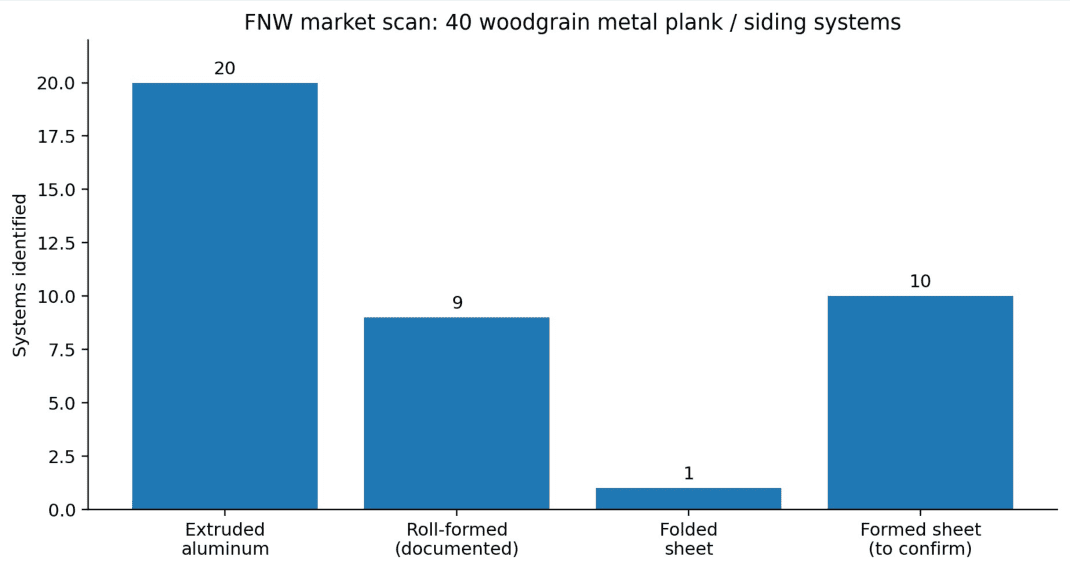
Figure 1. FNW market scan of 40 identified systems. The chart describes manufacturing documentation found during the
scan; it is not a claim that the global market contains only 40 products.
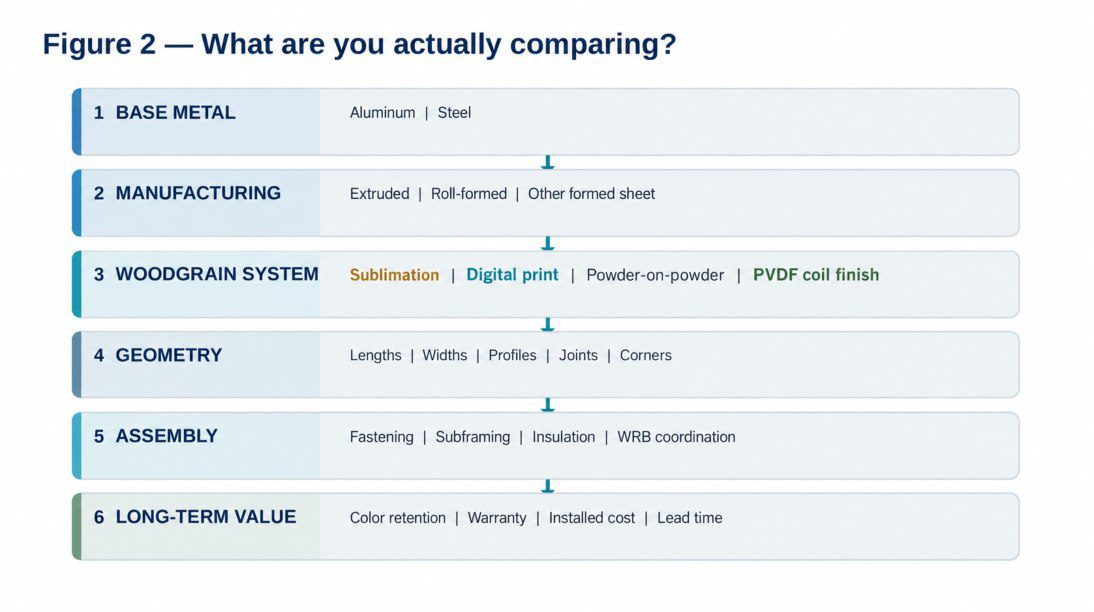
A sample board answers only one question: how does this finish look under these lighting conditions today? Some sample boards look better in your hand than they do on the wall, and the reverse can also be true. Digital print products are often created to read more naturally at architectural viewing distances, roughly 10 to 15 feet or more, so the impression from a handheld sample can differ from the finished elevation. A project team still needs to understand the metal, forming method, finish construction, profile geometry, available lengths, attachment system, warranty, exposure limitations, and installed cost.
1. Start With the Manufacturing Method
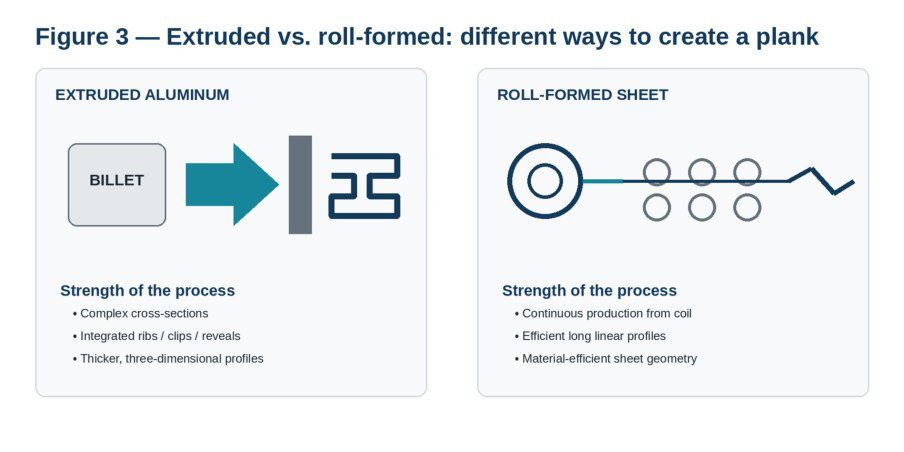
Two systems can create almost the same shadow line on an elevation while being manufactured in fundamentally different ways.
Extrusion pushes heated aluminum through a shaped die to create a continuous three-dimensional cross-section. That process can integrate ribs, channels, interlocks, clip interfaces and deeper profile geometry into a single piece. The Aluminum Extruders Council notes the wide range of solid, hollow and semi-hollow shapes possible with extrusion and emphasizes that ribs, grooves and other details can be incorporated directly into the profile. [2]
Roll forming starts with coil or sheet metal and progressively bends it through a sequence of rollers. The Metal Construction Association describes roll forming as a continuous process capable of producing dimensionally consistent profiled sheet in long runs. [3]
Extruded vs. roll-formed
| Question | Extruded | Roll-formed |
|---|---|---|
| Profile geometry | Can integrate substantial depth, ribs, hollow/semi-hollow geometry, clip features and complex reveals. | Efficient for repeated linear bends, interlocks, hems, ribs and plank geometries formed from sheet. |
| Typical substrate | Most woodgrain extrusion systems in this market scan are aluminum. | Both aluminum and steel are used; the identified architectural roll-formed group is heavily represented by steel. |
| Lengths | Long profiles are common, but handling, freight and thermal movement become important. | Continuous coil processing supports long production runs; product shipping lengths are still manufacturer-specific. |
| System detailing | Often comes with proprietary clips, extruded corners, joiners and coordinated trims. | Often relies on formed interlocks, starter pieces, trims and accessories; some systems nest or lap to hide end joints. |
| Cost implication | Do not assume ‘extruded = expensive’ without an installed-system comparison. | Continuous forming can be material-efficient, but finish, gauge, trims, labor, freight and waste can outweigh the forming method alone. |
Manufacturing method changes what a profile can do. It does not, by itself, determine which system is better.
2. Aluminum or Steel?
The base metal affects weight, corrosion behavior, thermal movement, profile design and the finish system used to create the wood appearance.
The Aluminum Association emphasizes aluminum’s high strength-to-weight ratio, corrosion resistance, durability and design flexibility. Aluminum forms a protective oxide layer naturally, and architectural pretreatments and coatings add another layer of protection. [4]
Steel offers high stiffness and impact resistance in relatively thin sheet. Exterior steel products depend on metallic coatings such as galvanizing or Galvalume plus an organic finish system to protect the substrate. Corrosion performance therefore depends on the complete coating system, cut-edge conditions, exposure and maintenance – not simply on the word ‘steel.’ [10-12]
| Issue | Aluminum | Steel |
|---|---|---|
| Weight / handling | Lighter; useful for long extrusions and overhead soffit work. | Heavier at comparable area, but thin roll-formed gauges can remain manageable. |
| Corrosion approach | Naturally corrosion resistant; architectural pretreatment and coating remain important, especially in aggressive exposures. | Relies on zinc/aluminum-zinc metallic protection plus paint/coating system; cut edges and damaged coating deserve attention. |
| Profile potential | Especially suited to three-dimensional extrusions with integrated features. | Especially suited to efficient formed sheet profiles and interlocks. |
| Thermal movement | Relatively high coefficient of expansion; long runs need intentional movement detailing. | Lower thermal expansion than aluminum, but long runs still require manufacturer-specific joint/detail review. |
| Impact / denting | Performance depends strongly on extrusion geometry and wall thickness. | Steel’s stiffness can be an advantage, but thin sheet can still dent; gauge and profile matter. |
| Coastal use | Can be an excellent choice when pretreatment, coating and fasteners are appropriate for the environment. | Can also perform well with the correct metallic/paint system; coastal exclusions or maintenance requirements must be checked. |
Do not select the metal in isolation. The substrate, pretreatment, decorative finish, fasteners and environment work as one durability system.
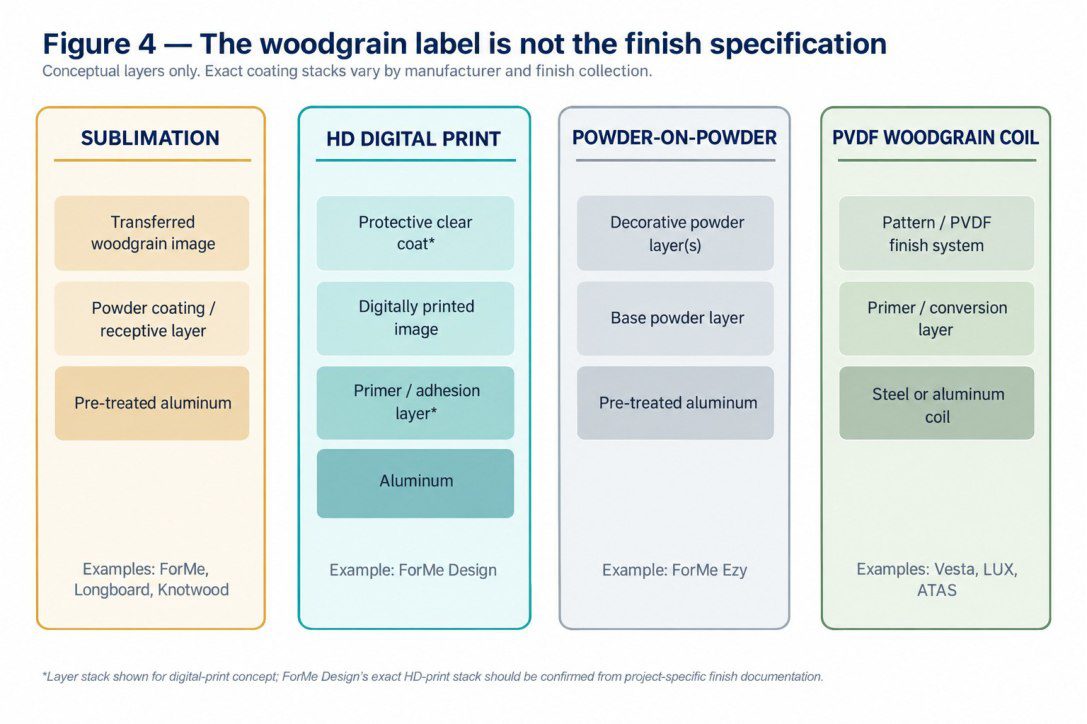
3. ‘Woodgrain’ Is Not One Finish Technology
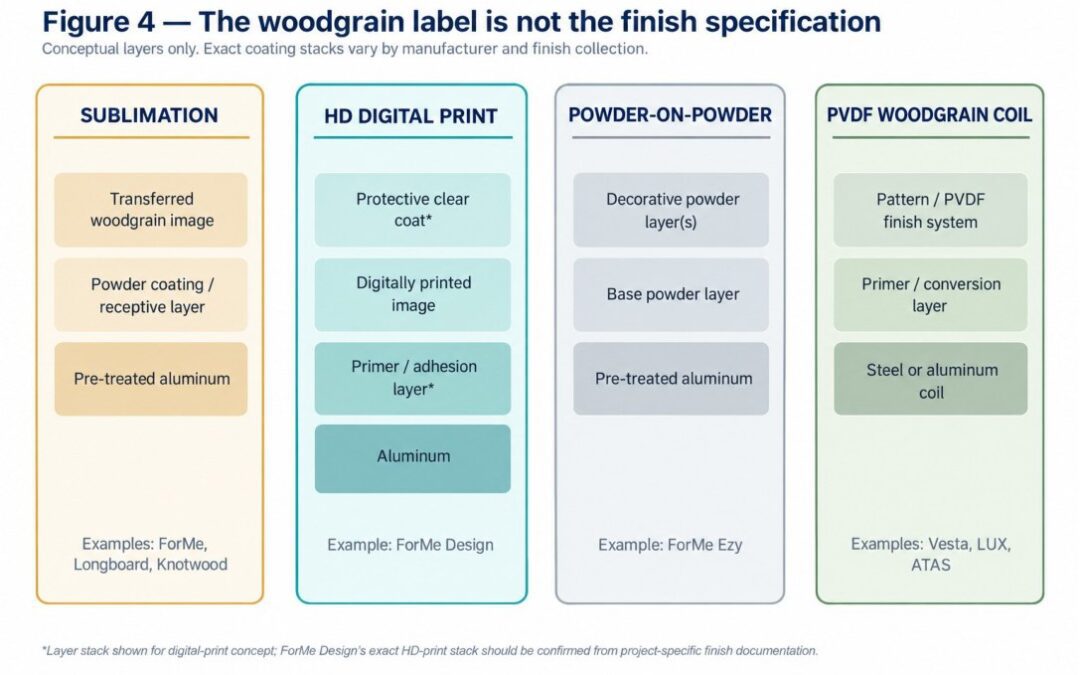
The market is often described as sublimated, digitally printed or powder coated. That shorthand is useful, but technically incomplete. Powder coating can be the decorative process itself, the receptive base for sublimation, or a solid-color finish. Roll-formed steel and aluminum can also use patterned PVDF coil finishes.
ForMe illustrates the distinction clearly: its current documentation identifies three wood-effect decoration technologies – high-definition digital printing, powder-on-powder decoration, and sublimation – on extruded aluminum. Longboard and Knotwood use sublimation with high-performance powder systems. Maibec also uses HD digital inkjet printing and publishes unusually detailed pattern-variation guidance. PVDF woodgrain / print systems are used by manufacturers including Vesta, LUX and ATAS. [6-13]
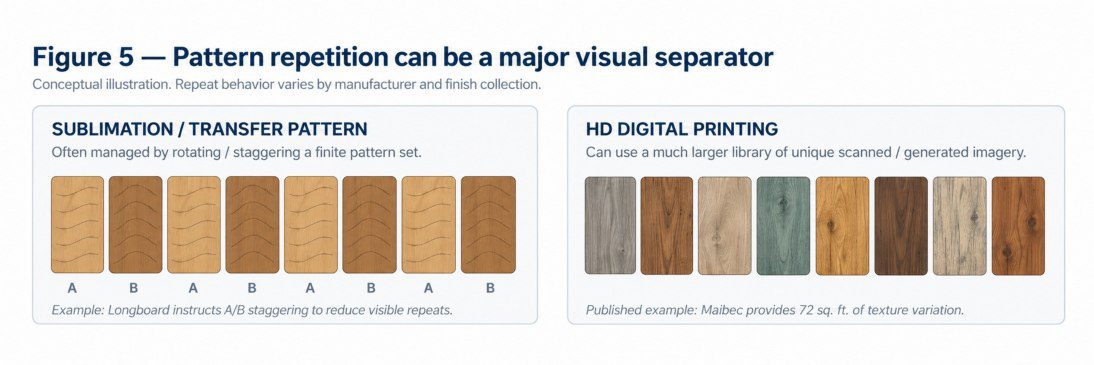
Pattern repetition can matter as much as finish chemistry
Among the systems reviewed, digital printing is the clear leader in pattern variety. A digital process can draw from a much larger library of scanned or generated imagery, reducing the chance that the same knot or grain feature appears again and again across the elevation. Maibec, for example, publishes 72 unique square feet of texture variation and instructs installers to randomize its printed plank faces. By contrast, Longboard’s sublimated woodgrains are published as repeating A/B patterns, with instructions to stagger adjacent planks by approximately 1 to 2 feet and build an onsite mock-up to create a more random appearance. [7, 8]
That does not mean every digitally printed product has no repeat, or that every sublimated product repeats at the same interval. It does mean pattern repetition should be treated as a design-performance criterion. Among the systems reviewed, digitally printed products provide the strongest path to large, varied image libraries and the least obvious repetition at facade scale. The project team should ask for the repeat length, number of unique patterns or unique texture area, and the manufacturer’s required staggering strategy before selecting a finish.
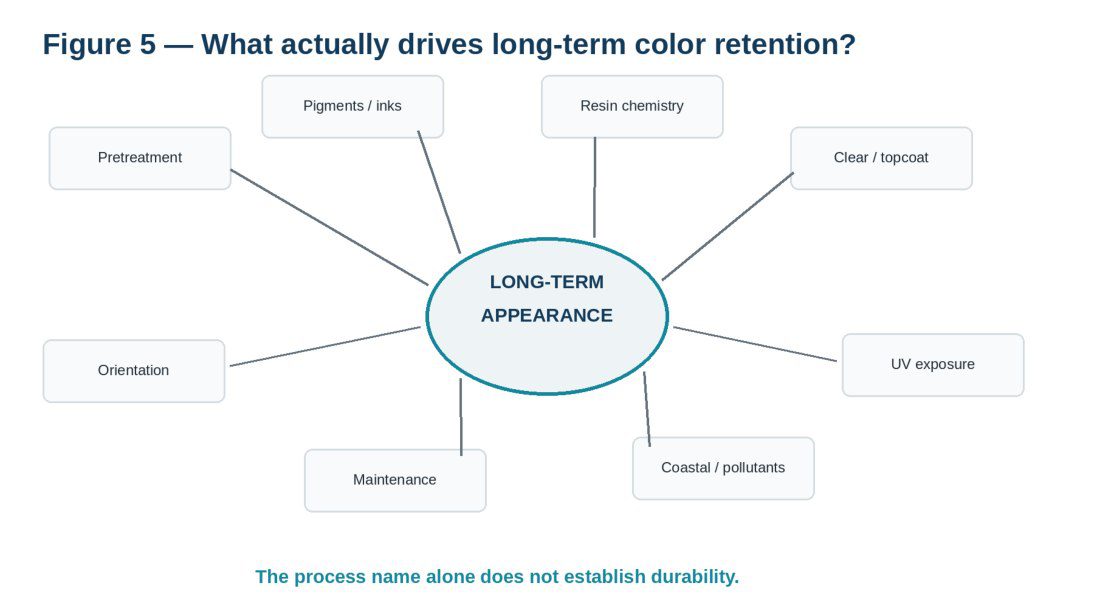
The finish label is not a durability rating. Ask what layers make up the finish, what weathering standard applies, and what the warranty actually measures.
4. What Actually Controls Color Retention?
Sublimation should not be assumed to provide superior long-term color retention. In a typical sublimated woodgrain system, the decorative image is transferred into or onto a powder-coated surface. The powder coating may have well-defined durability standards, but the project team still needs to determine whether the warranty specifically covers the woodgrain image, its color change, and its fade performance – or primarily the underlying coating.
That distinction is important. Some manufacturers explicitly warrant their sublimated woodgrain finishes, while others provide stronger or clearer performance language for the base coating than for the decorative image itself.
Digital printing has a different advantage: the image, clear coat, pigments or inks, and published color-retention limits can be engineered and documented as a complete finish system. Maibec, for example, publishes measurable color-change and gloss-retention criteria for its digitally printed finish. PVDF and powder-on-powder systems likewise need to be evaluated by their complete finish construction and published weathering performance.
A long warranty on the powder coating does not automatically mean the transferred woodgrain image has the same fade warranty.
FNW recommendation: When appearance quality, low pattern repetition, and long-term woodgrain performance are the leading priorities, start with digitally printed extruded aluminum and require image- specific fade/color-retention documentation.
AAMA 2604 and AAMA 2605 are useful benchmarks for architectural coatings on aluminum because they establish weathering, fade, chalk, gloss, adhesion, humidity and corrosion-performance requirements. A coating-industry summary of the FGIA standards identifies natural South Florida weathering benchmarks of five years for AAMA 2604 and ten years for AAMA 2605, with color change limited to less than 5 Delta E units. [5]
That does not mean every woodgrain product can be compared by simply asking ‘2604 or 2605?’ The standard must apply to the specific finish system being supplied. Steel coil products may instead rely on PVDF/Kynar specifications and manufacturer warranty criteria.
| Example | Finish construction | Published performance reference | Base-coat / coating warranty | Woodgrain image / color-retention coverage |
|---|---|---|---|---|
| Longboard woodgrain | Sublimation inks + polyurethane powder system | AAMA 2604 or 2605 | 15-year (2604) / 20-year (2605) non-prorated finish warranty. | Longboard currently lists woodgrain & specialty finishes under the finish warranty; verify the selected finish and warranty document. [7] |
| Maibec printed finish | Primer + HD inkjet + protective clear coat | Primer documented to AAMA 2604 | Primer, printed coat and clear protective coat are defined together as the PRINTED FINISH. | 20 years; color change <=5 CIE Lab units; >=50% gloss retention. [8] |
| ForMe wood-effect finishes | HD digital, powder-on-powder, or sublimation | AAMA 2604 / 2605 certifications listed; confirm exact collection | 15-year U.S. finish warranty; exact terms depend on finish and market. | Confirm whether the selected sublimated or decorative image has explicit color/fade coverage, not only the underlying coating. [6] |
| Knotwood | Sublimated image fused into powder-coated aluminum | AAMA 2604/2605 performance listed for profile/finish family | Powder-coated aluminum is part of the finish system; solid-finish terms differ. | Published training materials state a 15-year woodgrain finish warranty with stated fade limits; verify current project warranty. [9] |
For sublimated systems, separate the warranty on the powder-coated base from coverage of the transferred woodgrain image. A warranty that defines Delta E, chalk, gloss or image fade is more informative than a warranty period alone.
5. Lengths and Profiles Change the Elevation
The most obvious differences between products may show up not in the sample, but in the elevation. Standard lengths determine where butt joints occur, how material ships, how much waste is generated and how thermal movement is accommodated.
Longboard offers many tongue-and-groove profiles in 12- and 24-foot lengths. Maibec documents 16-foot standard planks. Knotwood Classic Boards are offered in 18-foot-6-inch and 21-foot lengths. Quality Edge Vesta lists 8-foot woodgrain planks, while EDCO Perspectives and LUXLAP use 12-foot modules. ATAS Homestead Rib adds a different value proposition: 8- and 12-inch concealed-fastener roll-formed panels in lengths from 3 feet to 26 feet 4 inches, available in .032 aluminum or 24-gauge metallic-coated steel with 70% PVDF colors and prints. [7-13]
Longer is not automatically better. A 24-foot extrusion can reduce end joints but increase freight, jobsite handling requirements and thermal-movement demands. A shorter roll-formed plank can be easier to ship and replace, but may create more visible joints unless the system provides a nesting or concealed joining strategy.
Profile depth matters too. A 4-inch plank with a tight reveal and a 6-inch plank with a deep shadow line can produce completely different scale and rhythm even when the woodgrain print is similar.
Before selecting a color, lay out the actual elevation with the manufacturer’s real plank lengths, joint rules, corners and trims.
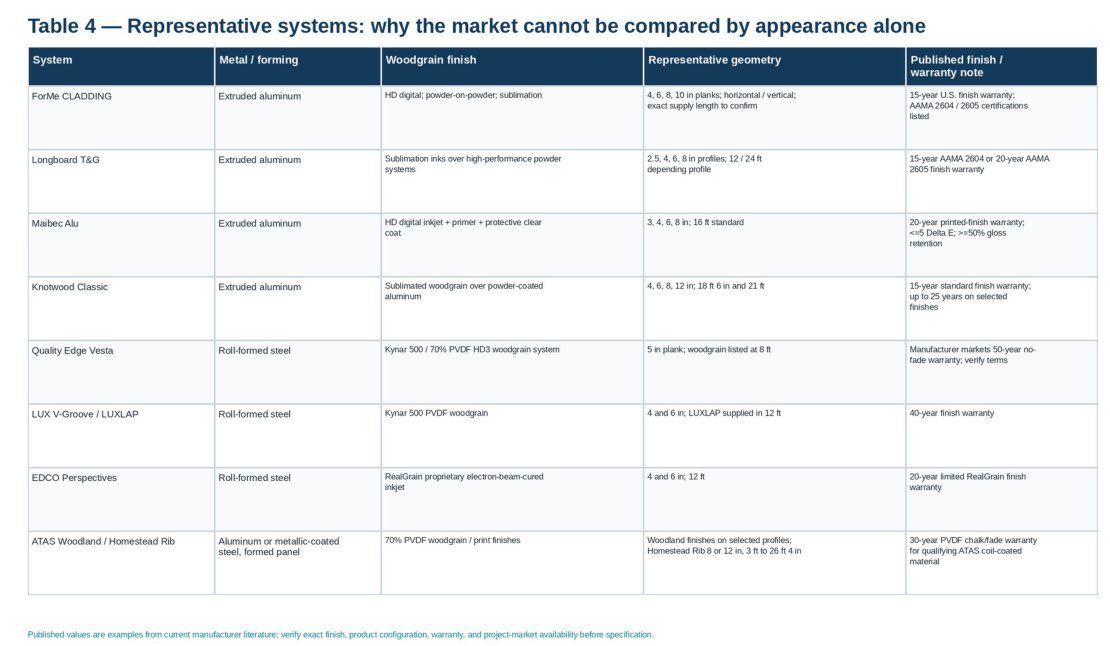
Table 4. Representative examples selected to illustrate differences in manufacturing, finish technology, dimensions and warranty language. This is not a
ranking.
6. Warranties: Read the Definition, Not Just the Number
Woodgrain metal warranties are not standardized. One manufacturer may advertise a 15-year finish warranty tied to AAMA performance. Another may offer 20 years with an explicit Delta E color limit. Another may market 40 or 50 years but define different remedies, ownership conditions, exclusions or proration.
For sublimated products in particular, separate the warranty on the powder-coated base from the warranty on the transferred woodgrain image. Do not assume they are identical. Some manufacturers expressly cover the woodgrain finish; others may provide broader or clearer protection for the base coating than for the decorative image.
For example, Maibec’s current printed-finish warranty defines color stability as no more than 5 CIE Lab units and requires at least 50% gloss retention over a 20-year period. Longboard publishes 15-year and 20-year non-prorated finish warranties tied to AAMA 2604 and 2605 systems. LUX publishes a 40-year finish warranty for Kynar 500 PVDF colors. Quality Edge markets a 50-year no-fade warranty for Vesta. EDCO Perspectives lists a 20-year limited warranty for RealGrain. [7-12]
Those numbers should not be put into a bar chart and treated as if they measure the same thing. They do not.
| Warranty question | What to look for |
|---|---|
| Color change | Is there a Delta E limit? How is it measured? Does the woodgrain image itself fall within the definition? |
| Chalking | Is chalk explicitly limited? What test method or rating is used? |
| Gloss retention | Is a minimum gloss-retention percentage defined? |
| Adhesion / cracking | Are delamination, checking, cracking or crazing addressed? |
| Corrosion | Is the substrate covered separately from the finish? What about cut edges? |
| Coastal exposure | Are there distance-from-coast exclusions, cleaning requirements or special pretreatment requirements? |
| Remedy | Repair, refinish, replacement, material only, labor allowance, proration? |
| Transfer / registration | Does coverage depend on original ownership, registration or transfer fees? |
Warranty years are a headline. The measurable acceptance criteria and remedy are the substance.
7. FNW Recommended Starting Point
After reviewing the market by substrate, forming method, finish technology, pattern repetition, warranty language, geometry, and cost structure, FNW would not begin with 40 equal choices. We would begin with two primary paths.
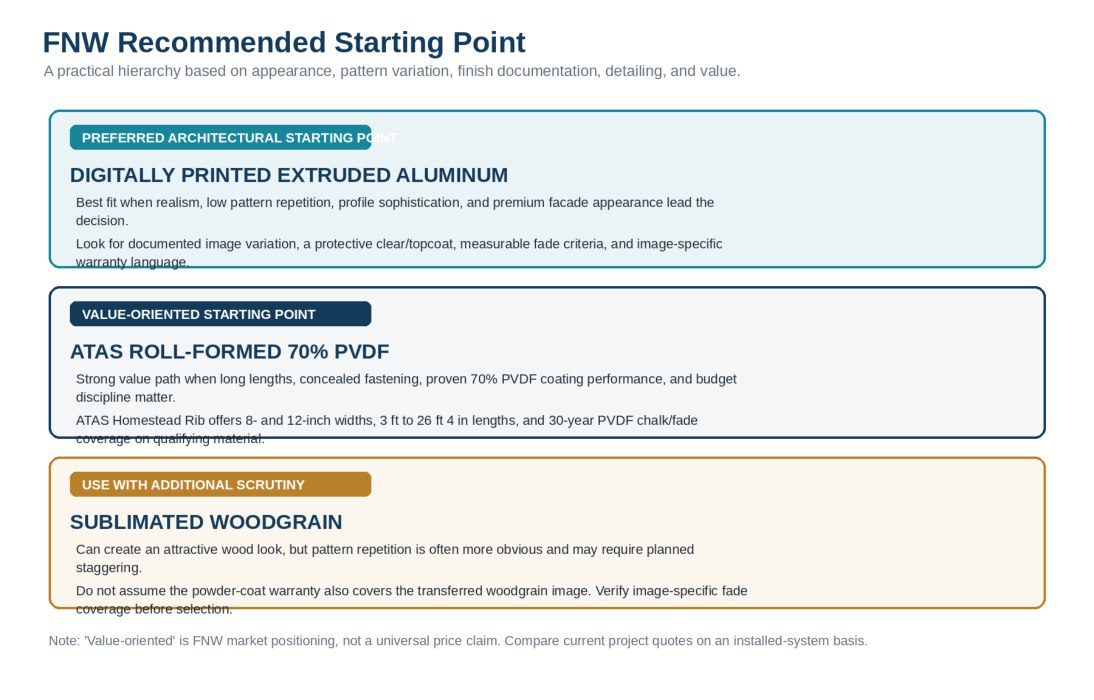
Preferred architectural path – digitally printed extruded aluminum. Start here when the design intent depends on realistic wood appearance, low visible repetition, sophisticated profile geometry, and a premium facade presentation. Systems such as ForMe and Maibec demonstrate why digital printing is important: the image library can be much broader than a
conventional repeating transfer pattern, and the finish can be built as a documented system of primer, digital image, and protective clear/topcoat. [6, 8]
Value-oriented path – ATAS roll-formed 70% PVDF. Start here when budget discipline, long panel lengths, concealed fastening, and proven PVDF coating performance matter more than achieving the lowest possible pattern repetition. ATAS Homestead Rib provides 8- and 12-inch coverage, 3-foot to 26-foot-4-inch lengths, aluminum or metallic-coated steel substrates, and a 30-year chalk-and-fade warranty for qualifying coil-coated PVDF material. [13] FNW considers this a value-oriented market position; actual project pricing must still be confirmed by comparable installed-system quotes.
Sublimation remains a viable aesthetic option, but it is not FNW’s first recommendation when long-term woodgrain appearance is the primary criterion. Pattern repetition is typically more visible, installation may require deliberate staggering, and the warranty must be read carefully to determine whether it covers the transferred woodgrain image or primarily the powder-coated base.
If an architect asks FNW, ‘Where should I start?’ our answer is: digitally printed extruded aluminum for the preferred architectural solution; ATAS roll-formed 70% PVDF for the value-oriented solution.
8. Price Positioning: Compare the Installed System
Public list prices are a poor basis for a technical comparison. Woodgrain systems are commonly sold through distributors or project quotations, and pricing can shift with finish, quantity, freight, custom lengths, accessories and project location.
Manufacturing method influences cost, but it does not determine it. Extrusions can integrate geometry and attachment features but may carry more aluminum by weight. Roll forming is a continuous process that can be highly material-efficient. Premium PVDF, hyper-durable powder, custom digital printing or specialty sublimation can materially change the finish cost. Proprietary clips, rails, trims and corners can also move an apparently inexpensive panel into a different installed-cost category.
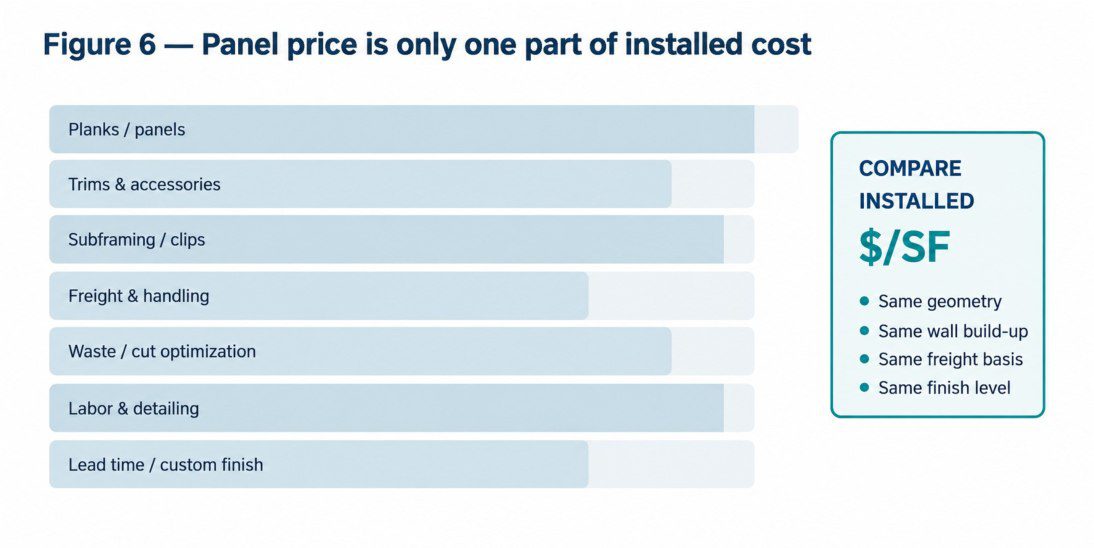
For bidding, compare systems on the same elevation and wall build-up. Include field panels, corners, starters, joiners, trims, attachment components, subframing, waste, freight, labor and lead-time risk. Then calculate an installed dollars-per-square-foot comparison.
Price positioning should be project-specific. A panel-only $/SF comparison can easily identify the wrong ‘low-cost’ system.
9. The Complete Wall Still Matters
Woodgrain metal siding is not the wall by itself. The selected plank still has to integrate with the rainscreen cavity, clips or subframing, exterior insulation, weather barrier, flashings, openings and transitions.
Some extruded systems use proprietary clips that intentionally accommodate thermal movement. Some roll-formed systems use concealed interlocks or formed locks. Others depend on conventional fasteners and trims. These details affect drainage, ventilation, replacement strategy, installer sequencing and thermal bridging.
A beautiful sample can therefore be the wrong choice if the system cannot achieve the required cavity depth, corner condition, soffit transition, opening detail or insulation thickness.
This is also where project-specific fire requirements matter. Metal cladding may be noncombustible, but the complete wall can still contain combustible insulation, membranes, attachments or other components that trigger separate code requirements. Product selection should remain coordinated with the wall assembly rather than treated as a finish-only exercise.
Compare the plank and the wall assembly at the same time. The best-looking sample is not automatically the best system.
10. A Practical Way to Narrow the Field
The market is too crowded for a one-product-at-a-time review. Start by deciding whether the project is pursuing the preferred architectural path (digitally printed extruded aluminum) or the value-oriented path (ATAS roll-formed 70% PVDF), then eliminate systems that do not meet the project’s exposure, geometry, warranty, schedule, and installed-cost requirements.
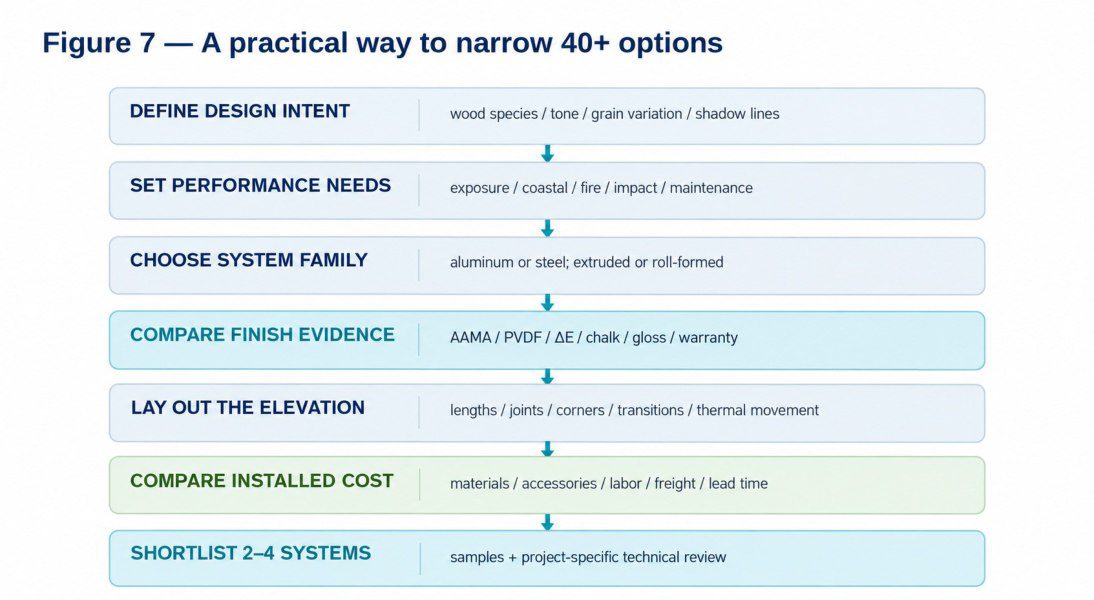
The process should end with physical samples and project-specific details, not begin with them. By the time the team requests final samples, it should already understand which systems satisfy the metal, manufacturing, finish, length, warranty, installation and budget requirements.
At that point, visual judgment becomes much more useful because the remaining products are genuinely comparable.
11. What We Would Ask Before Specifying a Woodgrain Metal Plank
- What is the base metal, alloy or steel coating, and thickness?
- Is the plank extruded, roll-formed or fabricated by another process?
- How is the woodgrain created: sublimation, HD digital print, powder-on-powder decoration, PVDF coil finish, or another method?
- What is the pattern repeat length, number of unique patterns, or unique texture area, and what staggering does the manufacturer require?
- What pretreatment, primer, clear coat or topcoat is part of the complete finish stack?
- Which weathering standard applies to the exact woodgrain finish being supplied?
- What are the published limits for fade, chalk and gloss retention?
- What does the finish warranty actually cover, and what is the remedy?
- What standard lengths and profile widths are available for the selected finish?
- How are butt joints, corners, terminations and field cuts handled?
- Can the system be installed horizontally and vertically?
- How does the attachment system accommodate thermal movement?
- What are the coastal restrictions and cleaning requirements?
- What is the installed cost after trims, clips, subframing, waste, freight and labor?
- What is the actual lead time for the selected finish and quantity?
The goal is not to identify one universally ‘best’ woodgrain metal siding. It is to identify which system best fits the project’s appearance, performance, detailing, budget and schedule.
Conclusion
With more than 40 woodgrain metal plank and siding systems in the market, selection cannot stop at the sample board. The research points to a practical hierarchy. For design-driven architectural applications, FNW would start with digitally printed extruded aluminum because it combines premium profile geometry with the strongest path to reduced pattern repetition and documented image-specific finish performance. For projects where budget and long lengths carry more weight, ATAS roll-formed 70% PVDF is the value-oriented alternative we would evaluate first.
Sublimation can still produce an attractive wood appearance, but it moves down the hierarchy when pattern repetition and long-term image retention are the leading criteria. The project team should verify the repeat strategy and confirm that warranty coverage applies to the transferred woodgrain image itself, not simply to the powder-coated base.
The most useful question is therefore not ‘Which of 40 products looks best in a sample?’ It is:
Does this project call for the premium appearance and low repetition of digitally printed extruded aluminum, or the value and long-length flexibility of an ATAS 70% PVDF roll-formed system?
References & Research Sources
[1] Facades Northwest market scan, November 2026. Forty brands/product systems identified from manufacturer websites; manufacturing classification remains subject to product-specific verification.
[2] Aluminum Extruders Council. Extrusion Design Tips / Key Design Considerations. Source
[3] Metal Construction Association. Metal Roofing A-to-Z, Section 5 – discussion of roll-forming as a continuous profiling process. Source
[4] The Aluminum Association. Building & Construction / Aluminum Properties. Source
[5] TIGER Drylac. Architecture Guide – summary of AAMA 2603/2604/2605 weathering performance requirements. Source
[6] ForMe Design / DFV Group. CLADDING technical information, Colors & Finishes, Test & Certification, and U.S. 15-Year Warranty. Current documents identify HD digital, powder-on-powder and sublimation wood-effect technologies. Source
[7] Longboard Architectural Products. Finishes, Quality, Tongue & Groove Plank technical information, and exterior T&G submittal package. Current literature identifies sublimated woodgrains over powder systems, AAMA 2604/2605 performance, 15/20-year finish warranties, 12/24-foot plank options, and repeating A/B woodgrain patterns with prescribed staggering. Source
[8] Maibec Architectural / Maibec Alu. Aluminum Planks, High-Definition Printing, Installation Guide, and Limited Warranty. Current documents identify HD digital printing, clear-coat protection, 16-foot standard planks, 72 square feet of texture variation, random pattern-distribution guidance, and printed-finish color/gloss criteria. Source
[9] Knotwood USA. Classic Boards, Manufacturing Process, Specification Data and Warranty information. Current literature identifies extruded aluminum, sublimated woodgrain over powder coat, 18-ft-6-in / 21-ft lengths and finish-warranty terms. Source
[10] Quality Edge. Vesta Plank Steel Siding and commercial product literature. Current information identifies roll-formed steel, Kynar 500 / PVDF woodgrain systems, 8-foot woodgrain planks and published no-fade warranty claims. Source
[11] LUX Architectural Products. V-Groove, LUXLAP, Colours, PVDF Paint Specifications and Warranty information. Current literature identifies 24-gauge steel, Kynar 500 PVDF woodgrains, 12-foot LUXLAP planks and 40-year finish warranty. Source
[12] EDCO Products. Perspectives Steel Siding specification and product guide. Current literature identifies roll-formed 26-gauge G90 steel, 12-foot planks, electron-beam-cured proprietary inkjet RealGrain finish and 20-year limited warranty. Source
[13] ATAS International. Woodland Series, Homestead Rib, color charts and warranty information. Current literature identifies 70% PVDF woodgrain / print finishes, selected aluminum and steel panel options, and 30-year limited chalk/fade coverage for qualifying ATAS coil-coated PVDF material. Source
[14] SteelConstruction.info. Corrosion Protection / Metallic Coatings. General background on galvanized steel and coating durability. Source
Publication note
This paper distinguishes published manufacturer information from FNW analysis. Manufacturer documents are cited as sources of product information, not endorsements of this paper. FNW’s preferred/value recommendations are analytical conclusions based on the criteria discussed in this paper and on market experience; they are not universal performance rankings or guarantees of project-specific price. Finish technologies, warranties, dimensions, availability and product formulations can change; verify current project-specific documentation and pricing before specification.
Download the original article
Download the original PDF with its original page layout, figures and references.
Questions about your building envelope? Contact Facades Northwest.