
A technical examination of whether dual-density construction provides meaningful wall-system benefits.
Dual-density mineral wool has become a familiar feature in exterior wall insulation. The concept sounds inherently advantageous: a harder, higher-density exterior surface combined with a softer, lower-density inner layer.
But there is a more important question for architects, consultants and contractors:
Does a rainscreen wall actually need two different insulation densities to perform properly?
A mono-density insulation board should not be excluded solely because of its density profile where its documented properties and applicable assembly approvals satisfy the project requirements.
Dual-density construction can change the handling and surface characteristics of the product. But those characteristics should not automatically be confused with improved performance of the completed wall assembly. The thermal, fire, moisture and durability functions expected of exterior mineral wool do not inherently depend on having two densities within a single board. [1]
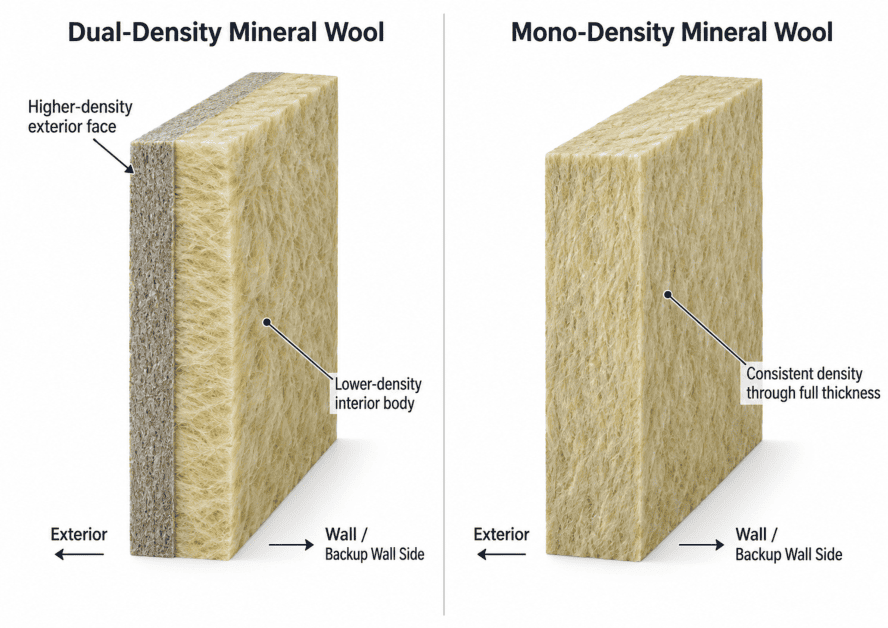
Figure 1 – Dual-Density vs. Mono-Density Mineral Wool. Dual-density mineral wool combines a higher-density exterior face with a lower-density interior body. Mono-density mineral wool maintains a consistent density through the full thickness of the board. Dual density is a product architecture; whether it provides a meaningful wall-system advantage depends on what the assembly actually requires.
What Is Dual-Density Mineral Wool?
A dual-density mineral-wool board combines two density zones within one piece of insulation.
In one manufacturer’s rainscreen board (Manufacturer A), the higher-density exterior layer is approximately 5/8 inch thick, while the remainder of the board is produced at a substantially lower density. The harder exterior layer is promoted for characteristics such as surface rigidity and durability, while the softer inner portion reduces overall board density and weight. [2]
That is a legitimate method of manufacturing a mineral-wool board.
A feature of the insulation product is not necessarily a requirement of the wall system.
The more meaningful question is whether two density zones provide a performance capability that cannot be achieved with a properly engineered mono-density board.
The 2.5-Inch Question
One of the most revealing aspects of the dual-density discussion is what happens at different insulation thicknesses.
Manufacturer A offers its rainscreen board at 1 inch, 1.5 inches and 2 inches as mono-density mineral wool for exterior cavity-wall and rainscreen applications. At 2.5 inches and greater, the product changes to a dual-density configuration. [1]
The physics of the rainscreen wall do not suddenly change when the insulation increases from 2 inches to 2.5 inches. The product architecture changes.
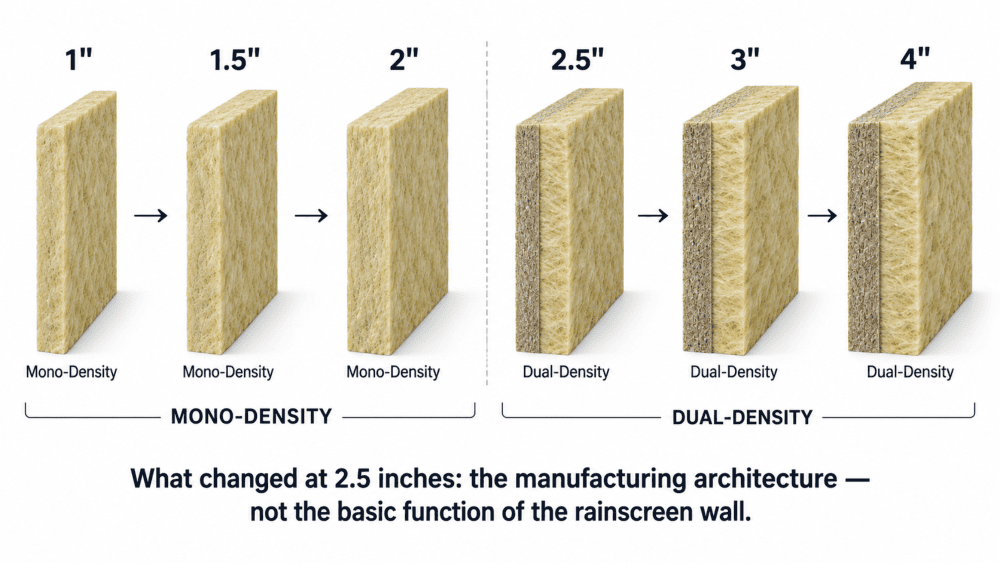
Figure 2 – Density Configuration by Thickness: Manufacturer A. This rainscreen product line is offered at 1″, 1.5″ and 2″ as mono-density construction and at 2.5″ and greater as dual-density construction. The graphic shows this manufacturer’s configuration, not a universal thickness threshold for mineral wool. [1]
If mono-density mineral wool is suitable for the same rainscreen application at 2 inches, the specification question at greater thicknesses should not automatically become:
“Does the insulation have two densities?”
It should remain:
“Does the insulation satisfy the performance requirements of the wall?”
In a Modern Rainscreen, the Insulation Is Not the Structure
This distinction becomes particularly important when exterior insulation is installed with thermally broken clips, girts or other engineered subframing.
The cladding loads are transferred through the attachment system back to the building structure. The mineral wool performs a different role. [2]
- Providing continuous thermal resistance
- Maintaining a durable fit around the attachment system
- Meeting applicable fire-performance requirements
- Resisting moisture while allowing appropriate vapor transmission
- Maintaining dimensional stability
- Retaining its required physical properties throughout the service life of the assembly
In the subframing arrangement discussed here, the engineered attachment system carries the cladding loads. The insulation should therefore be evaluated against the thermal, fire, moisture, attachment, retention, and other physical-property requirements that actually apply to it—not assumed to require a harder exterior face simply to support the cladding. [2]
Does the Harder Outer Face Improve Thermal Performance?
Not inherently.
The published data examined in this article shows both Manufacturer A’s rainscreen board and another manufacturer’s mono-density board (Manufacturer B) at approximately R-4.2 per inch. That means two density zones are not required simply to obtain the fundamental thermal performance expected from this class of mineral-wool insulation.
[1][4]
The other core functions normally required of exterior mineral wool – including fire performance, moisture management, dimensional stability, attachment compatibility and durable fit – also do not inherently require dual-density construction. Those properties can and should be evaluated individually.
Dual Density Also Makes the Board Directional
There is another practical difference that is easy to overlook.
The dual-density rainscreen board examined here has an intended exterior face. Manufacturer A’s attachment guide identifies the higher-density outer layer and the lower-density inner layer. [2]
Consistent with that designation, the higher-density face is positioned toward the exterior cladding or air cavity, and the lower-density face toward the backup wall. Full boards and cut pieces should retain this orientation.
- Identify the intended exterior face before positioning each board.
- Maintain the same face orientation when cutting around clips and girts.
- Check offcuts before reusing them elsewhere on the wall.
- Verify face orientation along with fit and securement.
A mono-density board has no high-density/low-density layer distinction to preserve when flipped. Separate facer or product-specific orientation instructions still apply.
The practical difference is a face-orientation check. The sources cited here do not quantify additional installation time or comparative error rates.
Figure 3 – Mineral Wool Installation Around Subframing
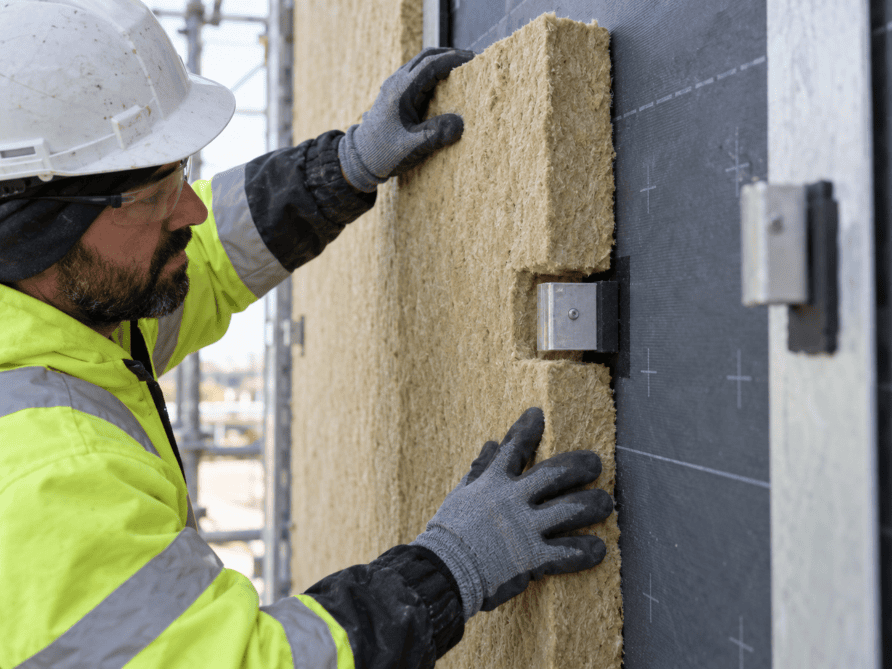
Illustration of the repeated cutting and fitting of mineral wool around rainscreen attachment components. AI-generated illustrative image; not a project photograph.
What Does the Wall Actually Need?
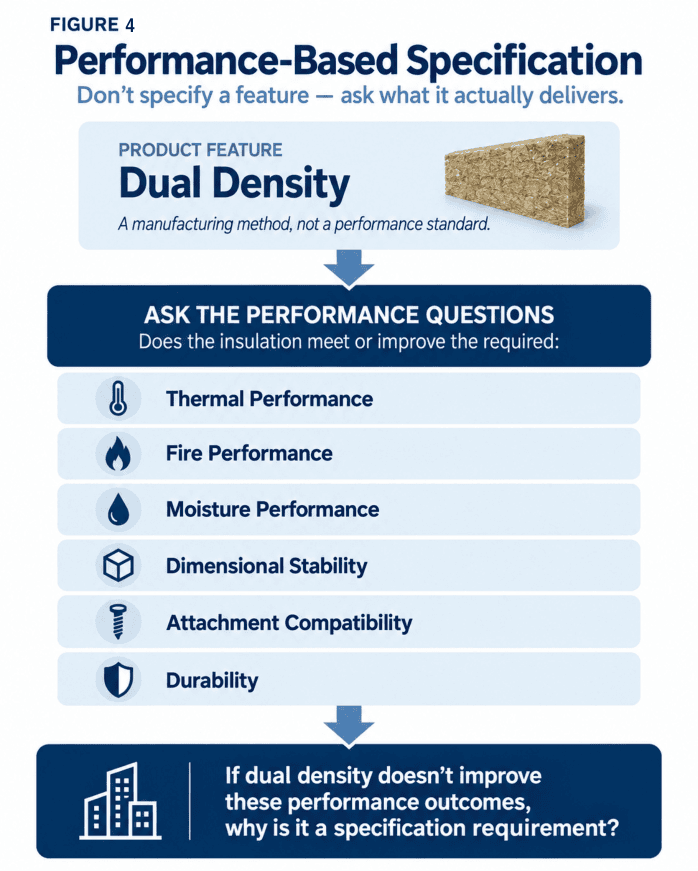
A rainscreen specification should ideally describe what the insulation must accomplish, rather than prescribe how one manufacturer chooses to construct the board.
- ASTM C612 classification
- Required insulation thickness and R-value
- Noncombustibility and surface-burning characteristics
- Moisture resistance and vapor permeance
- Dimensional stability
- Attachment and retention requirements
- Compatibility with the selected subframing
- Applicable NFPA 285 requirements
- Project-specific exposure or durability criteria
Those are measurable requirements. “Dual density” describes a manufacturing architecture.
If a specification requires dual density without identifying a measurable wall-system performance criterion that requires it, the specification may be prescribing how one manufacturer makes its product rather than what the wall actually needs to accomplish.
Where Mono-Density Mineral Wool Fits
None of this means that every mono-density mineral-wool board is equivalent. A mono-density product still needs to demonstrate that it meets the required physical and performance criteria of the project.
Manufacturer B, for example, publishes the following properties for its mono-density exterior insulation board:
[4][5][6]
- 4.5 pcf actual density
- R-4.2 per inch at 75°F under ASTM C518
- ASTM C612 compliance
- Noncombustibility classifications under ASTM E136 and CAN/ULC S114
- Flame-spread index of 0 and smoke-developed index of 0 under ASTM E84
- Published moisture, vapor and fungi-resistance information
- Thicknesses from 1.5 inches through 6 inches in 0.5-inch increments
This manufacturer also has higher-density products available when a project specification specifically demands them.
The board should be evaluated against the requirements of the wall – not against whether it duplicates another manufacturer’s density profile.
So, Do You Really Need Dual-Density Mineral Wool?
For a typical rainscreen wall, there is no demonstrated wall-system requirement that inherently requires dual-density mineral wool.
The harder exterior face does not carry the cladding, does not improve the published R-value per inch, and is not required to provide the fundamental fire, moisture, vapor, dimensional-stability or durability functions of the insulation. Those functions can be provided by a properly engineered mono-density mineral-wool board.
The remaining question for the designer is whether that architecture produces a meaningful improvement in the completed rainscreen wall.
If a properly engineered mono-density mineral wool already satisfies the thermal, fire, moisture, dimensional-stability, attachment and durability requirements of the assembly, there is no inherent wall-performance reason to require a second density.
The better question is not: “Is it dual density?”
The better question is: “What does dual density actually improve in this wall?”
If no measurable wall-system performance requirement can be identified, dual density should not automatically be treated as superior – or written into a specification simply because one manufacturer uses it.
References & Technical Sources
Manufacturer A and Manufacturer B are neutral editorial labels. Product descriptions below replace brand names; the linked original source documents identify the publishers and products. Manufacturer literature remains manufacturer literature, not independent comparative research.
[1] Manufacturer A – Rainscreen insulation technical data sheet, issued April 2026, page 2. Documents mono-density construction at 1″, 1.5″ and 2″, dual-density construction at 2.5″ and greater, and R-4.2 per inch at 75°F. View original source
[2] Manufacturer A – Board Insulation Attachment Guide, July 2022, pages 6 and 9. Identifies the higher-density outer layer (6.2 pcf; approximately 5/8″ thick) and lower-density inner layer (3.8 pcf); also addresses clip-, girt-and rail-supported insulation. View original source
[3] Manufacturer A – High-Performance Rainscreen Systems brochure. Describes the harder outer layer and softer inner layer characteristics. View original source
[4] Manufacturer B – Mono-density exterior insulation board product data. Publishes R-4.2 per inch at 75°F, density, fire, moisture, dimensional-stability and product-dimension information. View original source
[5] QAI – Manufacturer B mineral-fiber board listing. Third-party listing for mineral-fiber boards across multiple densities and applicable ASTM/CAN-ULC classifications. View original source
[6] National Research Council Canada – CCMC 14061-L. Product listing covering Manufacturer B mineral-fiber board products across multiple densities. View original source
Publication note
This article distinguishes published technical information from analysis. Product and assembly requirements should be evaluated for each project’s specific structural, fire, thermal, moisture and code conditions.
Manufacturer documents are cited as sources of published product information, not as endorsements of this article. Citing or linking to a source does not imply that its publisher approves this article or its conclusions. No manufacturer endorsement or approval is claimed.
Download the original article
Download the original PDF with its original page layout, figures and references.
Questions about your building envelope? Contact Facades Northwest.